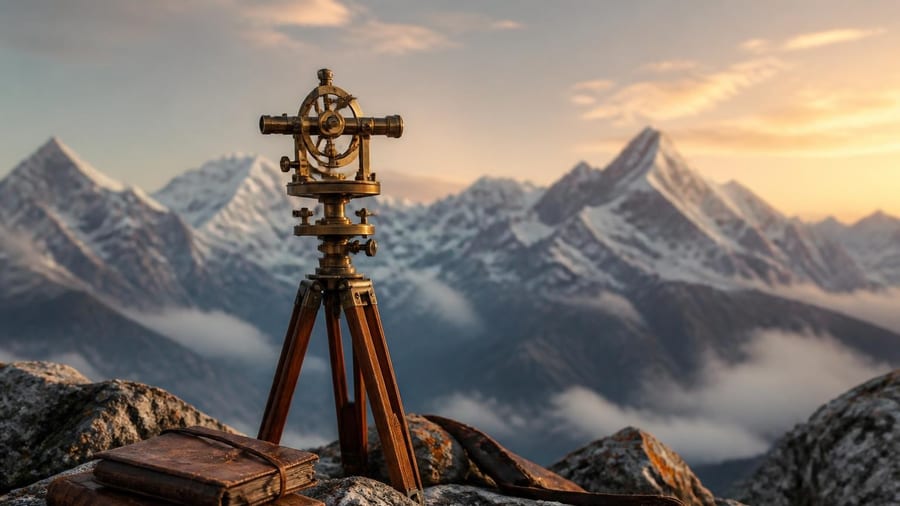
When British surveyors completed the first comprehensive measurement of Mount Everest in 1852, they faced an unusual dilemma. Their calculations, derived from six separate observation points across the Indian subcontinent, yielded a figure so neat it threatened to undermine their credibility: precisely 29,000 feet. In an era when scientific rigor was still establishing its foothold and skepticism toward colonial expeditions ran high, the team made a curious decision. They published the height as 29,002 feet—deliberately adding two feet to make their genuine measurement appear more believable.
This peculiar footnote in surveying history reveals as much about 19th-century scientific communication as it does about mountain measurement. The surveyors understood human psychology: round numbers suggest guesswork, while specific figures imply precision. Their small deception served a greater truth, ensuring their accurate work would be taken seriously rather than dismissed as an estimate.
The Challenge of Measuring the World's Roof
Measuring Everest from the plains of India presented extraordinary technical obstacles. The mountain sits more than 100 miles north of the closest accessible survey stations, requiring triangulation across vast distances through atmospheric distortion, heat shimmer, and the curvature of Earth itself. Survey teams used massive theodolites—precision angle-measuring instruments weighing hundreds of pounds—to calculate the peak's elevation above sea level.
The Great Trigonometrical Survey of India, which undertook this work, employed a network of observation points stretching across the subcontinent. Each station's elevation and position had to be meticulously calculated before surveyors could even attempt to measure distant Himalayan peaks. The mathematical complexity involved accounted for:
- Atmospheric refraction bending light rays
- Earth's spherical shape affecting line-of-sight calculations
- Temperature and pressure variations altering measurements
- Gravitational anomalies influencing plumb lines
That six independent measurements converged on exactly 29,000 feet represented remarkable accuracy for the era. Yet this precision became a public relations problem.
Why Scientists Fear Round Numbers
The surveyors' anxiety about their perfect figure wasn't paranoia. Throughout scientific history, round numbers have often signaled approximation rather than measurement. When ancient scholars estimated Earth's circumference or medieval cartographers guessed continental distances, they favored tidy multiples of ten or one hundred.
The first official survey of Everest took place in 1852. The surveyors took measurements in six places and derived an average figure of 29,000 feet, which seemed too much like a round-number estimate for an official report.
By adding two feet, the survey team signaled that they had measured, not estimated. This small fabrication actually preserved the integrity of their data in the public eye. For more than a century, 29,002 feet stood as Everest's official height—a testament to both the surveyors' skill and their understanding of how scientific claims gain acceptance.
Modern Measurements and Moving Mountains
Everest hasn't remained static. The Survey of India revisited the peak in 1954, employing more sophisticated instruments and methodologies. Their conclusion: 29,028 feet (8,848 meters). This figure became the internationally accepted standard for decades, though not without ongoing debate.
Mountains in the Himalayas continue to change height due to tectonic activity. The Indian subcontinent pushes northward into the Eurasian plate at roughly 2 inches per year, causing the mountain range to rise. Simultaneously, erosion from wind, ice, and weather gradually wears peaks down. The net effect varies by location and timeframe.
A 2015 earthquake in Nepal prompted concerns that Everest might have shrunk. The magnitude 7.8 quake caused significant geological shifts across the region, leading to speculation about whether the summit had lowered. A joint Nepal-China expedition in 2019-2020 settled the question, measuring the peak at 8,848.86 meters (29,031.7 feet)—nearly three feet taller than the 1954 measurement.
The Snow Cap Controversy
Not all disagreements about Everest's height stem from measurement error. A fundamental question divides surveyors: should the official height include the snow and ice cap, or measure only to the rock beneath?
| Method | Measurement | Rationale |
|---|---|---|
| Rock height (China) | 8,844.43 meters | Permanent geological feature |
| Snow height (Nepal/International) | 8,848.86 meters | Actual summit point |
| Difference | ~4.43 meters (14.5 feet) | Depth of snow/ice cap |
Chinese surveyors traditionally preferred measuring to bedrock, arguing that snow accumulation varies with weather patterns and climate. Other nations counter that the summit—the point climbers actually stand on—is what matters, regardless of whether it's rock or compacted snow. The 2020 joint survey resolved this diplomatic tension, with both countries agreeing on the snow-inclusive figure.
Everest's Competitors for Tallest Mountain
Calling Everest the tallest mountain depends on your definition. It's unquestionably the highest point above sea level, but other peaks claim superiority by different metrics. Mauna Kea in Hawaii measures 33,500 feet from base to summit—significantly taller than Everest's approximately 15,000-foot rise from its Tibetan Plateau base. Most of Mauna Kea sits underwater, with only its upper third visible above the Pacific.
If distance from Earth's center matters most, Ecuador's Mount Chimborazo wins. Earth bulges at the equator due to its rotation, placing Chimborazo's summit nearly 6,800 feet farther from the planet's core than Everest's peak, despite Chimborazo reaching only 20,564 feet above sea level.
These distinctions matter for different scientific purposes. Atmospheric scientists care about height above sea level, since air pressure and oxygen availability depend on that measure. Geologists studying mountain formation focus on base-to-peak measurements. Astrophysicists calculating orbital dynamics consider distance from Earth's center.
Legacy of the Two-Foot Fudge
The 1852 surveyors' decision to add two feet illustrates an enduring tension in science communication. Accuracy doesn't always appear credible, and sometimes a small departure from truth serves broader truthfulness. Their fabrication ensured their legitimate work received the recognition it deserved.
Modern surveying technology—GPS, satellite radar, laser ranging—eliminates much of the ambiguity that plagued 19th-century measurements. Yet the fundamental challenges remain: defining what we're measuring, accounting for change over time, and communicating scientific findings in ways that build rather than erode public trust.
This article discusses historical surveying practices and current geological measurements. For technical applications requiring precise elevation data, consult current authoritative geodetic surveys.