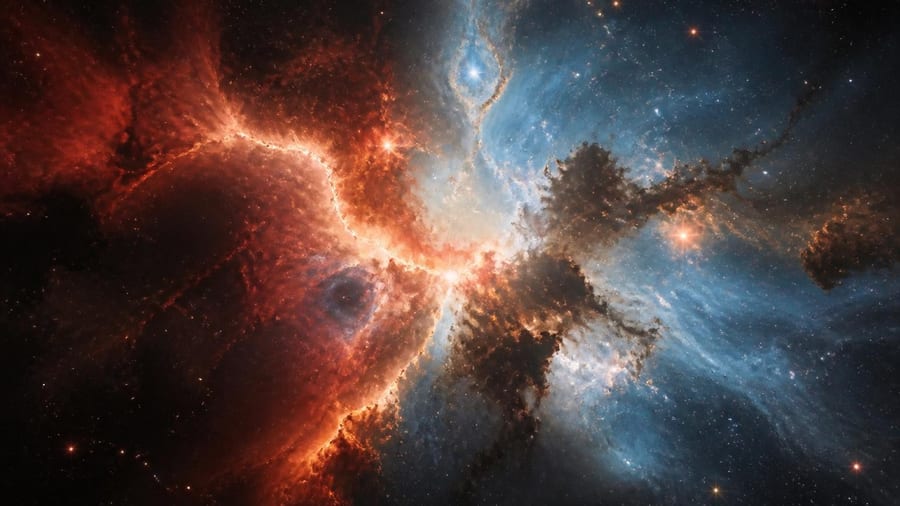
Deep in the cold, dark expanses of molecular clouds, where gravity coalesces gas and dust into nascent stars, a remarkable transformation takes place. The violent shock waves that radiate outward from newly forming protostars create conditions that rival the most sophisticated chemistry labs on Earth. These cosmic laboratories, operating at temperatures ranging from a few hundred to several thousand degrees Kelvin, drive reactions that produce organic molecules — building blocks that may eventually seed planetary systems with the chemistry necessary for life.
Understanding how these protostellar environments generate complex molecules has profound implications. It connects stellar birth to the emergence of chemical complexity in the universe, bridging astrophysics, astrochemistry and even the origins of biological precursors. Recent observational campaigns using radio interferometry have revealed that shock fronts in star-forming regions are far more chemically active than previously imagined, challenging models that assumed most organic synthesis occurred only on icy grain surfaces.
The Engine Behind Protostellar Shock Waves
When a protostar forms, material from the surrounding envelope falls inward under gravity, but not all of it lands smoothly on the growing stellar core. Jets and outflows, driven by magnetic fields threading the accretion disk, blast outward at velocities exceeding 50 kilometers per second. Where these supersonic flows collide with the ambient molecular cloud, they produce shock waves — abrupt discontinuities in density, temperature and pressure.
These shock fronts compress and heat the gas, temporarily breaking apart stable molecules such as carbon monoxide and water. Within milliseconds, the liberated atoms recombine in new configurations, forming species that cannot exist in the frigid, quiescent regions of the cloud. Molecules such as methanol, formaldehyde, acetaldehyde and even more complex organics emerge from this high-energy cauldron. The process is remarkably efficient: a single shock passage can elevate local gas temperatures to 2,000 Kelvin or higher, sustaining chemistry for tens to hundreds of years before the region cools and equilibrates.
Molecular Complexity in Extreme Conditions
Observational evidence from millimeter and submillimeter telescopes has cataloged more than 200 distinct molecular species in interstellar and circumstellar environments. Many of these are detected specifically in the shocked regions around protostars. The inventory includes not only simple diatomic and triatomic molecules but also nitrogen-bearing organics, sulfur compounds and even carbon chains with up to a dozen atoms.
Shock chemistry in protostellar environments transforms simple ice mantles into a molecular zoo, producing organic precursors that later populate protoplanetary disks and, ultimately, planets.
The diversity arises because shock waves perform two critical functions. First, they vaporize icy grain mantles that have accumulated over millions of years in the cold cloud. Second, they inject energy that drives endothermic reactions — processes requiring heat input that would never occur in the undisturbed cloud at 10 Kelvin. The result is a transient but intense period of chemical synthesis, a natural analog to industrial catalytic cracking or plasma reactors, but operating at scales measured in light-years.
Observational Techniques and Recent Discoveries
Mapping the chemistry of protostellar shock waves requires instruments capable of detecting faint emission lines at millimeter and submillimeter wavelengths. Facilities such as the Atacama Large Millimeter/submillimeter Array have revolutionized the field, offering angular resolution fine enough to resolve shock fronts just hundreds of astronomical units across — roughly the scale of our own solar system.
Key discoveries in the past decade include:
- Detection of methanol masers tracing shock-heated gas in Herbig-Haro objects, where protostellar jets impact the interstellar medium.
- Identification of formamide and acetonitrile in protostellar outflows, molecules relevant to prebiotic chemistry.
- Mapping of sulfur-bearing species such as sulfur monoxide and sulfur dioxide, which serve as sensitive tracers of shock conditions.
- Observations of deuterium fractionation patterns that reveal the thermal history of shocked material.
These findings underscore that shock waves are not merely destructive events; they are crucibles of molecular innovation, seeding the interstellar medium with complex organics that later incorporate into planets and comets.
Implications for Planetary Chemistry and Astrobiology
The molecules forged in protostellar shock waves do not remain in the outflow forever. As the shock slows and cools, newly synthesized species condense back onto dust grains or become incorporated into the protoplanetary disk surrounding the young star. This disk is the birthplace of planets, and its chemical inventory directly influences the composition of rocky worlds and icy bodies.
Comets and asteroids that bombarded the early Earth likely carried organics originally synthesized in such shock environments. Spectroscopic studies of comet volatiles reveal compounds — methanol, formaldehyde, hydrogen cyanide — that match the molecular signatures of shocked protostellar gas. The implication is striking: the raw materials for life on Earth may have been prepared billions of years earlier in the violent outflows of a nascent Sun.
Understanding this cosmic assembly line helps astrobiologists frame the question of life's prevalence. If protostellar shock chemistry is ubiquitous across star-forming regions, then the seeding of planetary systems with organic precursors is a standard outcome of stellar birth, not a rare accident. This perspective shifts the focus from whether organic molecules are delivered to planets to how efficiently they are transformed into biology once they arrive.
Laboratory Analogs and Future Research
Reproducing protostellar shock conditions in terrestrial laboratories remains a formidable challenge, but progress is being made. Shock-tube experiments and laser-driven plasma chambers can simulate gas-phase reactions at temperatures and pressures relevant to astrophysical shocks. By comparing laboratory spectra with astronomical observations, researchers refine reaction networks and kinetic models that predict molecular abundances in real protostellar environments.
Future space missions and ground-based observatories will push sensitivity and resolution even further. The goal is to trace individual shock fronts over time, watching molecules form, migrate and freeze out in near real-time — a molecular movie of stellar birth. Such observations will constrain models of grain-surface versus gas-phase chemistry, test theories of shock propagation and reveal whether the chemical richness observed in our own solar system is typical or exceptional.
| Molecule | Formula | Relevance |
|---|---|---|
| Methanol | CH₃OH | Grain mantle tracer, organic precursor |
| Formaldehyde | H₂CO | Gas-phase synthesis marker |
| Acetaldehyde | CH₃CHO | Complex organic intermediate |
| Sulfur monoxide | SO | Shock diagnostic, temperature probe |
| Formamide | NH₂CHO | Prebiotic chemistry candidate |
Ethical and Philosophical Considerations
While the study of protostellar chemistry is rooted in physics and astronomy, its findings touch on deep questions about humanity's place in the cosmos. If the molecules essential for life are manufactured routinely in stellar nurseries across the galaxy, the case for widespread biogenesis strengthens. This has implications for how we search for extraterrestrial life, prioritize missions to icy moons and asteroids, and interpret the results of exoplanet atmospheric surveys.
Moreover, the realization that Earth's organic inventory may trace back to violent stellar outflows millions of years before the Sun formed invites humility. The chemistry that animates every living cell on our planet began not in a primordial soup on Earth's surface, but in the shock-heated gas of a long-extinct protostellar jet, light-years away.
This information does not replace advice from a qualified professional in astrophysics, astrochemistry or related fields. Readers interested in detailed technical models should consult peer-reviewed literature and consult with research institutions.