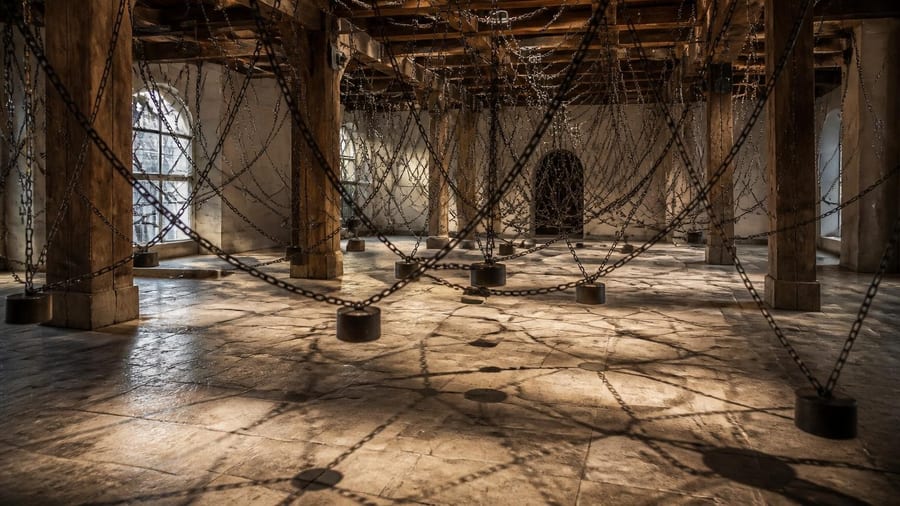
In the early 1900s, Antoni Gaudí suspended chains, ropes, and cloth bags weighted with birdshot from a wooden frame in his Barcelona workshop. The resulting inverted network of curves and arches became the structural blueprint for the crypt at Colònia Güell, a textile workers' colony near Barcelona. More than a century later, that analog experiment stands as one of architecture's pivotal moments—a bridge between intuitive craftsmanship and the computational design philosophies that define parametricism today.
Parametric design relies on algorithms to generate forms that respond to constraints such as load, material properties, and environmental forces. While Gaudí worked without computers, his hanging models embodied the same logic: physical forces shaped geometry, and structure determined aesthetics. Understanding how the Catalan master arrived at his solutions offers insight into the roots of a movement that now dominates avant-garde architecture.
The Hanging-Model Method Explained
Gaudí's technique hinged on a simple principle: a hanging chain or cable naturally assumes a catenary curve under its own weight. When inverted, that curve becomes an ideal compression arch, distributing loads efficiently without requiring heavy reinforcement. By draping strings weighted with small fabric sacks from a ceiling frame, Gaudí could simulate complex three-dimensional vaults and see their optimal geometry in real time.
He photographed the models, then flipped the images to reveal the final vault shapes. Assistants translated measurements from the photographs into scaled drawings and plaster maquettes. The process was iterative: adjusting a single weight altered the entire system, forcing recalculation of neighboring elements. This feedback loop—change one parameter, observe the cascading effect—is the conceptual heartbeat of parametric modeling software such as Grasshopper and Rhino.
Form-Finding Versus Form-Making
Traditional architecture begins with a preconceived shape—an architect sketches a dome or a vault, then engineers determine how to support it. Gaudí reversed that workflow. His hanging chains were form-finding devices, allowing gravity to dictate geometry. The resulting structures were not imposed from above but emerged from physical laws.
Gaudí demonstrated that efficient form is discovered, not invented—a philosophy that underpins contemporary computational design.
This distinction resonates in parametricism, where designers encode rules and constraints into algorithms, then let the software explore thousands of permutations. The architect's role shifts from drawing a fixed plan to curating parameters and selecting optimal outcomes. Zaha Hadid Architects and Bjarke Ingels Group, among others, have adopted workflows in which structural analysis, environmental simulation, and fabrication constraints feed back into the design in real time, echoing Gaudí's iterative adjustments.
Digital Descendants: From Chains to Code
In the 1990s, architects began adapting engineering software originally developed for aerospace and automotive industries. Tools such as CATIA enabled freeform surfaces that defied Euclidean geometry. Parametric platforms emerged in the 2000s, offering visual scripting environments that made algorithmic design accessible to practitioners without programming backgrounds.
Contemporary projects demonstrate the lineage clearly:
- The Heydar Aliyev Center in Baku features flowing, load-optimized shells that recall the continuous curvature of catenary vaults.
- The Sagrada Família itself, completed using digital models based on Gaudí's original hanging studies, bridges analog intuition and computational precision.
- Morphosis's Perot Museum in Dallas employs parametric façade systems that respond to solar orientation, climate data, and structural loads—variables Gaudí manipulated with weights and strings.
These buildings share a conceptual DNA: structure and ornament fuse into a single, performance-driven envelope. Decoration is not applied; it is the visible manifestation of underlying forces.
Material Intelligence and Fabrication
Gaudí's models also anticipated advances in digital fabrication. Because his forms emerged from physical laws, they could be built with local materials—brick, stone, tile—arranged in patterns that followed natural stress lines. Modern parametric architects extend this logic using robotic milling, 3D printing, and prefabricated modular components. The ICD/ITKE Research Pavilion at the University of Stuttgart, for example, uses robotic arms to weave carbon-fiber shells whose geometry is calculated to optimize stiffness and minimize material waste.
| Aspect | Gaudí's Method | Parametric Design |
|---|---|---|
| Form Generation | Hanging chains, gravity | Algorithms, force simulation |
| Iteration | Physical adjustments, photography | Real-time software feedback |
| Fabrication | Handcrafted molds, skilled labor | CNC milling, robotic assembly |
| Principle | Form follows force | Form follows constraint |
Both approaches treat the building as an integrated system rather than an assemblage of separate elements. Walls, columns, and roofs converge into continuous surfaces that carry loads efficiently while expressing structural logic visually.
Limits and Critiques
Parametricism's champions argue it democratizes complexity, enabling buildings that adapt to site, climate, and function. Critics counter that the style can privilege novelty over habitability, producing sculptural objects that neglect human scale and cultural context. Gaudí's work offers a counterargument: his structures were fantastical yet deeply rooted in local tradition, materiality, and religious symbolism. The Colònia Güell crypt, though incomplete, functions as a parish church whose vaults, columns, and mosaics serve liturgical and communal purposes.
Contemporary parametric projects sometimes lack that grounding. When algorithms generate form solely from abstract datasets—wind vectors, pedestrian flows, budget constraints—the result can feel arbitrary. Gaudí's genius lay in balancing technical innovation with narrative, turning structural necessity into spiritual metaphor. Modern practitioners face the challenge of embedding similar meaning into computationally derived designs.
Legacy and Ongoing Research
Scholars continue to study Gaudí's models using photogrammetry, 3D scanning, and finite-element analysis. These investigations confirm that his intuitive methods often matched or exceeded the performance of structures designed with modern engineering software. The hanging models at Colònia Güell, preserved and exhibited at the site's interpretation center, remain active teaching tools. Architecture schools worldwide replicate the experiments, asking students to build their own chain models before moving to digital platforms.
This pedagogical sequence underscores a key lesson: parametricism is not merely a software technique but a mindset that respects material behavior, environmental context, and the interplay of forces. Gaudí's analog genius demonstrated those principles a century before processors made them scalable. His crypt stands as proof that revolutionary ideas need not wait for new technology—they simply need a curious mind willing to let nature guide the pen.
This information does not replace advice from a qualified structural engineer or architectural professional. Always consult licensed experts for building design and construction.