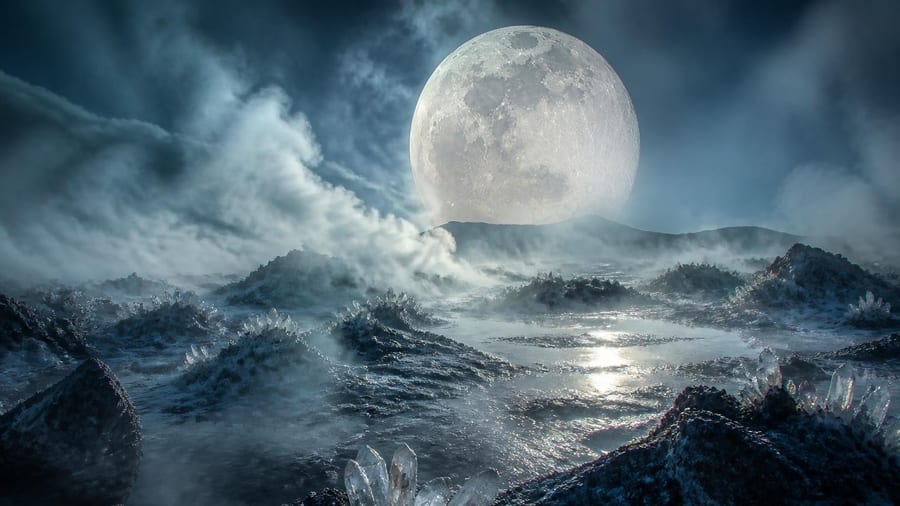
When scientists search for habitable worlds beyond Earth, they typically look for liquid water, a stable atmosphere, and a rocky surface. But emerging research suggests that the earliest stages of life's emergence might have required something far more dramatic: a colossal moon orbiting close to a young planet, paired with an atmosphere thick with steam. This unusual combination may have set the stage for the complex chemistry that eventually gave rise to living organisms.
Understanding how life began on Earth remains one of science's most profound puzzles. While we know that simple organic molecules eventually organized into self-replicating systems, the environmental conditions that enabled this transition have long been debated. New models in planetary formation and atmospheric chemistry are now pointing to a scenario that sounds more like science fiction than textbook geology—yet the evidence is mounting that our planet's infancy was stranger and more violent than previously imagined.
The Role of a Massive Lunar Companion
Earth's Moon is unusually large compared to our planet—about one-quarter the diameter of Earth itself. Most moons in the solar system are tiny compared to their host planets, making our lunar companion an outlier. According to the leading theory, the Moon formed roughly 4.5 billion years ago when a Mars-sized object collided with the proto-Earth in a catastrophic impact. This event, known as the Giant Impact Hypothesis, melted much of Earth's surface and ejected debris into orbit that eventually coalesced into the Moon.
In its earliest days, the Moon orbited much closer to Earth than it does today—perhaps only 15,000 to 20,000 miles away, compared to the current distance of about 240,000 miles. At this proximity, the Moon's gravitational influence on Earth was profound. Tidal forces would have been extreme, generating massive internal heating in Earth's mantle and crust through a process called tidal flexing. This heating kept the young planet's surface molten and geologically active, creating conditions ripe for volcanic outgassing.
The tidal interactions also accelerated Earth's rotation, shortening the day to perhaps just five to six hours. This rapid spin influenced atmospheric circulation patterns and ocean currents in ways that would have distributed heat and chemical compounds across the planet's surface more efficiently than on a slower-rotating world.
Steam Atmosphere Conditions After Impact
The Giant Impact that created the Moon released an enormous amount of energy—enough to vaporize oceans and create what planetary scientists call a "steam atmosphere." For thousands of years following the collision, Earth's atmosphere was dominated not by nitrogen and oxygen as it is today, but by water vapor at temperatures exceeding 1,000 degrees Fahrenheit at the surface.
A steam atmosphere represents a transient but crucial phase in planetary evolution, where the boundary between ocean and sky essentially disappears.
This thick blanket of water vapor acted as a powerful greenhouse gas, trapping heat and maintaining surface temperatures high enough to keep rock partially molten. Over time, as the planet gradually cooled, the steam began to condense. Rain—likely lasting for millennia—fell onto the cooling rock, creating the first stable bodies of liquid water. But during the steam phase itself, unique chemical reactions were possible.
The high temperatures and pressures in a steam atmosphere can drive reactions between water vapor and minerals in the upper crust. These conditions favor the formation of hydrogen-rich compounds and can break down complex silicate minerals, releasing elements like phosphorus, sulfur, and iron—all essential for biochemistry. The steam atmosphere essentially acted as a planetary-scale pressure cooker, synthesizing organic precursors that would later accumulate in the cooling oceans.
Chemical Pathways to Organic Molecules
Life as we know it requires several key ingredients: carbon, hydrogen, oxygen, nitrogen, phosphorus, and sulfur, often remembered by the acronym CHNOPS. While these elements were present on early Earth, they needed to be assembled into more complex molecules like amino acids, nucleotides, and lipids. The steam atmosphere and tidal heating provided energy sources and catalytic surfaces to drive these reactions.
- Volcanic outgassing released carbon dioxide, methane, ammonia, and hydrogen sulfide into the steam atmosphere
- Lightning strikes and ultraviolet radiation provided energy to break and reform chemical bonds
- Mineral surfaces in hydrothermal systems acted as templates for organizing simple molecules into more complex structures
- Tidal heating maintained long-lived hydrothermal vent systems on the seafloor, creating chemical gradients
Hydrothermal vents—fissures in the ocean floor where superheated, mineral-rich water emerges—are now considered prime candidates for the origin of life. The gradient between hot, chemically reducing fluids from the vents and the cooler, more oxidizing ocean water creates natural electrochemical cells. These gradients can drive the synthesis of organic molecules without requiring external energy input, a process that may have operated continuously for hundreds of millions of years on early Earth.
Comparing Earth to Other Planetary Systems
Not every rocky planet develops the conditions that led to life on Earth. Scientists now recognize that the Moon's formation and early proximity were not inevitable outcomes but rather the result of specific circumstances in our solar system's history. This realization has implications for the search for life beyond Earth.
| Planetary Feature | Earth (Early) | Venus | Mars |
|---|---|---|---|
| Large moon present | Yes | No | No (2 small moons) |
| Extended steam phase | Yes | Likely | Brief/uncertain |
| Long-term plate tectonics | Yes | No | No |
| Stable magnetic field | Yes | No (lost) | No (lost) |
Venus may have experienced a steam atmosphere phase, but without a large moon to drive tidal heating and stabilize its rotation, and without plate tectonics to cycle carbon, the planet entered a runaway greenhouse state. Mars, being smaller, cooled more quickly and lost its magnetic field, allowing solar wind to strip away much of its atmosphere. Earth's combination of factors—large moon, sustained internal heat, and eventual atmospheric stabilization—appears to have been particularly favorable.
Implications for Astrobiology and Exoplanet Research
As astronomers discover thousands of exoplanets orbiting distant stars, the question arises: how common are Earth-like conditions? Current telescope technology can determine a planet's size, orbit, and sometimes atmospheric composition, but detecting moons remains extremely difficult. Yet the presence of a large moon might be a crucial factor in determining whether a planet can develop and sustain life.
Some researchers now advocate for prioritizing exoplanets in binary planet systems—worlds with unusually large moons—in the search for biosignatures. The James Webb Space Telescope and future observatories may be able to detect indirect signs of large moons, such as variations in a planet's transit timing or wobbles in its motion caused by the moon's gravity.
The steam atmosphere phase also has implications for interpreting atmospheric spectra. A young rocky planet with high concentrations of water vapor might be in a pre-biotic phase similar to early Earth, making it a target of interest even if it doesn't yet show signs of life. Conversely, a planet that skipped this phase might be less likely to have developed the chemical foundations for biology.
Open Questions and Future Research
Despite advances in planetary science, many details about Earth's early history remain uncertain. The exact duration of the steam atmosphere phase, the composition of the pre-biotic ocean, and the timeline of the Moon's outward migration are all active areas of research. Computer models continue to refine our understanding, but direct evidence from 4 billion years ago is scarce—most rocks from that era have been destroyed by geological processes.
Missions to the Moon, including sample return from ancient lunar highlands, could provide new constraints on the timing and nature of early Earth-Moon interactions. Similarly, studying other moons in our solar system—particularly those with subsurface oceans like Enceladus and Europa—may reveal whether the chemistry enabled by tidal heating can occur in environments very different from early Earth.
This article presents current scientific theories and models regarding planetary formation and the origin of life. These are areas of active research, and new evidence may refine or revise our understanding. This information does not replace consultation with qualified scientific experts in geology, astrobiology, or planetary science.