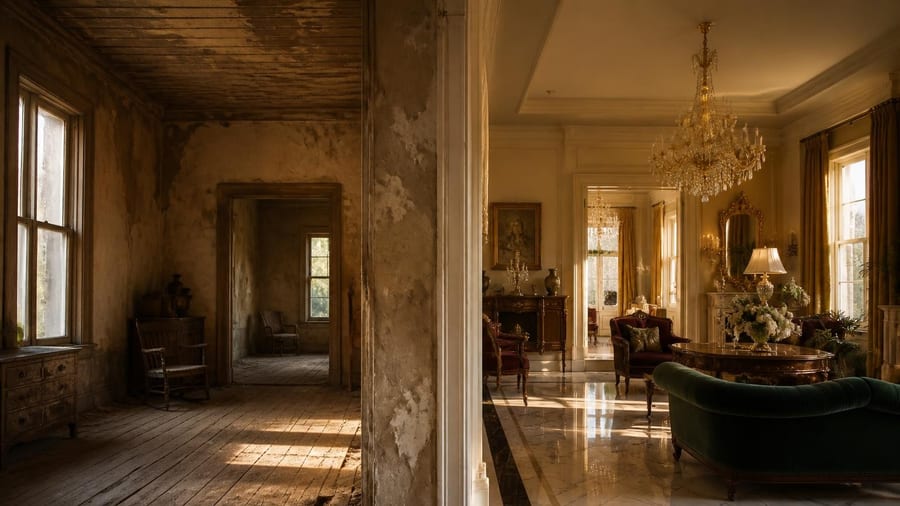
The residential story of Elvis Presley reads like an American fairy tale—a narrative arc from a simple two-room structure in Mississippi to one of the nation's most-visited private estates. These dwellings, captured in archival photographs, reveal more than architectural details. They chronicle the transformation of a working-class Southern boy into a cultural phenomenon whose influence persists nearly five decades after his death.
Understanding where Elvis lived offers insight into both his personal evolution and the broader American Dream narrative that defined mid-20th-century culture. His homes weren't merely addresses; they were statements about identity, success, and the power of entertainment to reshape one's destiny.
The Humble Beginnings in Tupelo
Elvis Aaron Presley entered the world on January 8, 1935, in a modest shotgun-style house in Tupelo, Mississippi. His father Vernon, alongside family members, constructed this 450-square-foot dwelling with their own hands—a testament to Depression-era self-reliance. The house featured just two rooms and minimal amenities, reflecting the economic hardship that gripped rural Mississippi during that period.
Financial strain forced the family to lose this home to repossession when Elvis was only three years old. The Presleys then moved through a succession of rental properties in Tupelo, never achieving stable housing. This instability left an indelible mark on the young Elvis, who would later channel his experiences into an almost obsessive pursuit of security and comfort.
By 1948, the family relocated to Memphis, Tennessee, seeking better economic opportunities. They settled in Lauderdale Courts, a federally subsidized housing development. While an improvement over their previous circumstances, the cramped apartment underscored the family's continued financial struggles. These formative years in government housing would contrast sharply with Elvis's later acquisition of a sprawling estate.
The Purchase That Changed Everything
Elvis's meteoric rise in the music industry began in the mid-1950s with his signing to RCA Records and a string of chart-topping releases. By early 1957, at just 22 years old, he possessed the means to purchase a property that would become synonymous with his legacy. He paid $102,500 for a Colonial Revival mansion located on Highway 51 South in Memphis—a sum equivalent to roughly $1.1 million today.
The estate, originally constructed in 1939 by physician Thomas Moore and his wife Ruth, had been named after their daughter Grace. The name persisted through subsequent ownership changes, and when Elvis acquired the property, "Graceland" became permanently linked to rock and roll royalty. The original structure offered over 10,000 square feet of living space set on nearly 14 acres of land.
The mansion represented not just shelter, but vindication—a physical manifestation that the boy from public housing had transcended the limitations of his birth.
Elvis immediately set about personalizing the estate to reflect his unique tastes and newly acquired wealth. He commissioned custom modifications that ranged from practical to extravagant, creating a residence that mirrored both his personality and the flamboyant aesthetic of his era.
Architectural Modifications and Personal Touches
The singer's vision for Graceland extended far beyond the mansion's original design. Early renovations included distinctive features that showcased his evolving style preferences:
- Installation of ornate wrought-iron gates featuring musical notes and silhouettes of Elvis with his guitar
- Construction of a kidney-shaped swimming pool surrounded by stone paving
- Addition of a full soda fountain—a nostalgic nod to the youth culture of the 1950s
- Custom upholstery and furniture pieces, including an oversized sofa designed for entertaining
- Expansion of the original floor plan to eventually encompass 23 rooms across 17,500 square feet
Perhaps the most famous addition came later: the Jungle Room, a den decorated with Polynesian-inspired furnishings, green shag carpeting covering both floor and ceiling, and exotic wood carvings. This space reflected Elvis's fascination with tropical aesthetics and became the site of his final recording sessions in the mid-1970s.
The estate's grounds also underwent significant development. Elvis added stables for horses, a racquetball court, and eventually a meditation garden that would become his final resting place. Each modification served as both a personal indulgence and a buffer against the outside world, creating a self-contained sanctuary where the entertainer could retreat from public scrutiny.
Other Residences in the Elvis Portfolio
While Graceland remained his primary residence and emotional anchor, Elvis maintained or temporarily occupied several other properties throughout his career. During his military service from 1958 to 1960, he rented a house in Bad Nauheim, Germany, where he lived with family members who had accompanied him overseas. This period of relative normalcy contrasted with the chaos of his civilian celebrity life.
In California, Elvis rented and occasionally purchased homes in Los Angeles and Palm Springs to support his film career and provide West Coast bases of operation. These properties, while luxurious, never achieved the iconic status of his Memphis mansion. They served functional purposes rather than representing permanent statements of identity.
The pattern reveals an important aspect of Elvis's relationship with home: Graceland wasn't simply real estate—it was refuge, symbol, and throne combined into one location. No other property could compete with its significance in his personal mythology.
The Museum Years and Cultural Legacy
Following Elvis's death on August 16, 1977, Graceland faced an uncertain future. Maintenance costs for the sprawling estate created financial pressure on his estate. In 1982, Priscilla Presley made the decision to open Graceland to public tours, transforming the private residence into a museum dedicated to preserving Elvis's memory and generating revenue to sustain the property.
The gamble proved spectacularly successful. Today, Graceland attracts approximately 600,000 visitors annually, making it the second-most-visited residential property in the United States—trailing only the White House. Tours showcase preserved rooms exactly as they appeared during Elvis's lifetime, offering visitors a glimpse into the daily environment of one of America's most influential entertainers.
| Feature | Description | Significance |
|---|---|---|
| Living Room | White furniture, stained-glass peacocks | Formal entertaining space |
| Jungle Room | Green shag, Polynesian decor | Recording studio, personal retreat |
| Meditation Garden | Elvis's gravesite, family memorials | Final resting place, pilgrimage site |
| Trophy Building | Gold records, awards, costumes | Career achievement documentation |
The museum complex has expanded beyond the mansion itself to include exhibition spaces displaying stage costumes, gold records, vehicles, and personal artifacts. This comprehensive preservation effort ensures that future generations can connect with Elvis not just as a musical abstraction, but as a real person who occupied physical space and left tangible traces of his existence.
Reflections on Architecture and Identity
Elvis Presley's residential journey—from a repossessed shack to a mansion visited by millions—encapsulates themes central to American culture: upward mobility, the transformative power of talent, and the democratization of luxury through popular entertainment. His homes serve as architectural bookends to a life lived at extraordinary velocity and intensity.
The photographs documenting these spaces do more than satisfy curiosity about celebrity lifestyles. They provide evidence of how environment shapes identity and how success, when achieved against steep odds, often manifests in the creation of personal kingdoms that offer both comfort and protection from a demanding world.
This article presents historical and cultural information about residential properties and does not constitute professional advice regarding real estate, historic preservation, or museum curation.