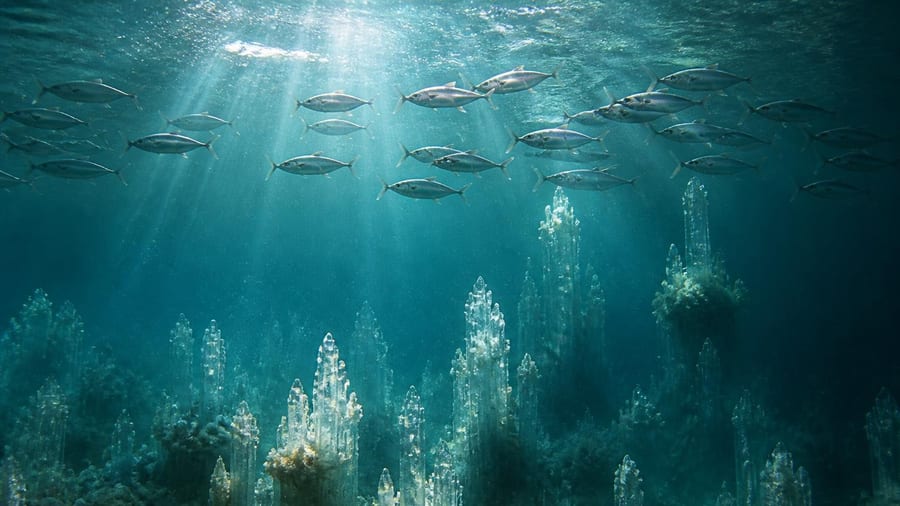
Scientists have uncovered a remarkable biological process hidden inside the digestive systems of ocean fish: a partnership between fish and their gut microbes that produces calcium carbonate minerals capable of trapping atmospheric carbon. This discovery adds a new dimension to our understanding of the ocean's role in regulating Earth's climate and opens questions about how marine ecosystems contribute to long-term carbon storage.
The process centers on the unique chemistry occurring in fish intestines. As fish digest their meals, specialized bacteria in their guts facilitate the formation of calcium carbonate crystals—the same compound found in seashells and coral skeletons. When fish excrete these mineral pellets into the water column, the carbon bound within them sinks toward the seafloor, potentially remaining sequestered for thousands of years.
The Chemistry Behind the Partnership
Fish intestines provide an ideal environment for mineral formation. The high pH levels in fish digestive tracts, combined with the presence of calcium ions from seawater and food, create conditions where calcium carbonate precipitation becomes thermodynamically favorable. Microbial communities residing in fish guts appear to accelerate this process through their metabolic activities.
Researchers estimate that marine fish collectively produce between 3 and 15 million metric tons of calcium carbonate each year through this pathway. The minerals form as tiny pellets, often measuring just micrometers in diameter, yet their cumulative impact on ocean carbon cycling may be substantial. Unlike organic matter that decomposes relatively quickly, these mineral-bound carbon stores resist breakdown.
The ocean absorbs roughly 25% of human-generated carbon dioxide annually, but the mechanisms driving this uptake remain incompletely understood.
Implications for Ocean Carbon Sequestration
The ocean's ability to absorb and store carbon dioxide plays a critical role in moderating global temperatures. Traditional carbon sequestration pathways include photosynthesis by phytoplankton and the physical dissolution of CO₂ into seawater. The fish-microbe mineral production pathway represents a biological pump that operates independently of these better-known mechanisms.
What makes this process particularly interesting is its stability. Organic carbon from dead plankton and other biological material often remineralizes before reaching deep water, releasing CO₂ back into the water column. Calcium carbonate minerals, by contrast, are chemically stable and dense enough to sink rapidly, reducing the likelihood of carbon returning to the atmosphere on human timescales.
Key characteristics of this carbon pathway include:
- Production occurs continuously wherever fish populations exist
- Minerals are excreted directly into the water column, bypassing surface processes
- Carbon storage timescales extend from centuries to millennia
- The process operates across diverse marine environments, from coastal waters to open ocean
The Microbial Contributors
The bacteria living in fish intestines are not passive passengers. These microbial communities perform essential digestive functions while also influencing the chemical conditions that favor mineral precipitation. Specific bacterial groups appear to enhance carbonate formation through enzymatic activities that alter local pH and ion concentrations.
Fish species vary considerably in their gut microbiome compositions, which may affect mineral production rates. Herbivorous fish that consume algae and plant material host different bacterial communities than carnivorous species, potentially leading to variations in carbonate output. Temperature, salinity, and diet all influence which microbial taxa colonize fish digestive systems.
| Fish Type | Diet | Estimated Mineral Output |
|---|---|---|
| Herbivorous reef fish | Algae, seagrass | High (alkaline gut conditions) |
| Pelagic carnivores | Other fish, squid | Moderate (protein-rich diet) |
| Bottom-feeders | Sediment, detritus | Variable (diverse microbiomes) |
Broader Ecosystem Connections
This fish-microbe interaction does not exist in isolation. Healthy fish populations depend on intact marine food webs, clean water, and suitable habitat. Overfishing reduces the number of fish available to produce these carbon-trapping minerals, potentially diminishing this natural carbon sequestration pathway. Climate change itself threatens fish populations through ocean warming, acidification, and deoxygenation.
Coral reef ecosystems, which support 25% of all marine species despite covering less than 1% of the ocean floor, harbor particularly dense fish populations. The degradation of reef systems due to warming waters and pollution thus carries implications not only for biodiversity but also for carbon cycling processes that depend on fish abundance.
Conservation efforts that protect fish populations may therefore deliver climate benefits beyond the carbon stored in marine biomass itself. Maintaining robust fish communities ensures the continuation of mineral-based carbon sequestration alongside other ecosystem services such as nutrient recycling and habitat provision.
Research Frontiers and Unknowns
Scientists are working to quantify how much this pathway contributes to total ocean carbon uptake. Measurement challenges include tracking tiny mineral pellets in vast ocean volumes and determining what fraction of excreted carbonates ultimately reaches long-term storage in seafloor sediments. Ocean currents, water depth, and pellet density all influence whether minerals settle permanently or redissolve before burial.
Future research directions include:
- Mapping mineral production rates across different ocean regions and fish communities
- Identifying which bacterial species drive carbonate formation most efficiently
- Assessing how ocean acidification affects this process
- Determining the fate of fish-produced minerals over decadal to centennial timescales
Understanding these dynamics could inform marine conservation strategies and improve climate models that project future atmospheric CO₂ concentrations. As researchers continue investigating the intricate relationships between fish, microbes, and ocean chemistry, the picture of Earth's carbon cycle grows richer and more complex.
This information does not replace advice from a qualified professional in marine science, environmental policy, or climate research.