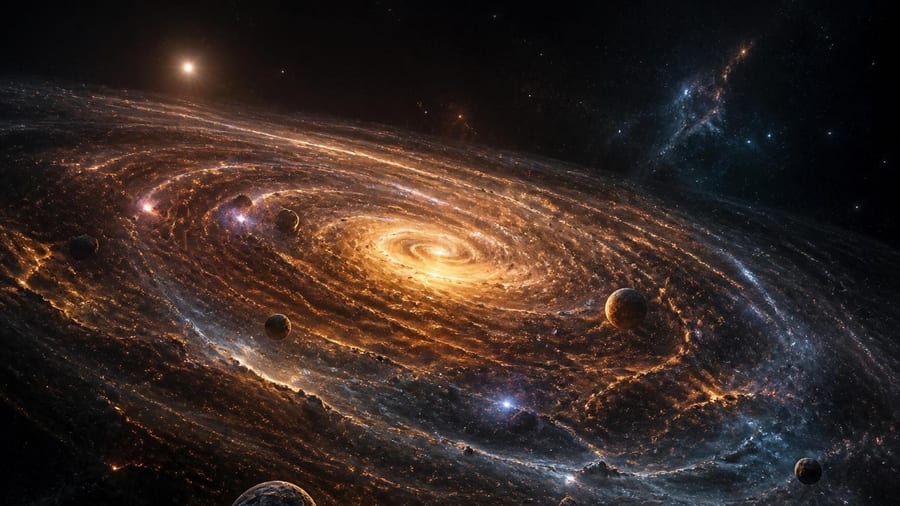
For decades, astronomers have mapped planets circling stars scattered across the Milky Way and beyond. Yet new theoretical research suggests the cosmos may harbor an entirely different category of planet factories: the roiling, high-energy zones surrounding supermassive black holes at the hearts of galaxies. These extreme environments, once thought too hostile for planet formation, could assemble worlds in ways utterly foreign to the quiet stellar nurseries we observe around Sun-like stars.
The hypothesis challenges conventional wisdom. Planets typically coalesce from disks of gas and dust orbiting young stars, where gravity gradually pulls small grains into pebbles, then boulders, and eventually terrestrial or gas-giant worlds. Supermassive black holes, by contrast, sit in regions where gravitational tides can rip matter apart and where radiation streams outward at devastating intensity. Nevertheless, recent models propose that under the right conditions, dust and gas can survive long enough—and in sufficient density—to trigger planet assembly even in these infernos.
Accretion Disks as Cosmic Forges
At the core of many galaxies lies a black hole millions to billions of times the mass of the Sun. Matter spiraling inward forms an accretion disk, a swirling vortex of superheated plasma that glows across the electromagnetic spectrum. Within these disks, temperatures soar to millions of degrees near the event horizon, but conditions cool farther out. It is in these cooler, outer zones—tens of light-years from the black hole itself—that theorists believe planets might form.
Dust grains in the disk can stick together through electrostatic forces and low-velocity collisions. If the disk is massive and dense enough, gravity may bind these aggregates into planetesimals, objects ranging from meters to kilometers across. Over millions of years, planetesimals could merge into full-fledged planets, orbiting not a star but the gravitational anchor of the black hole. Models suggest such planets might range from rocky bodies to ice giants, depending on temperature gradients and chemical composition within the disk.
"The physics of accretion disks around supermassive black holes shares surprising commonalities with protoplanetary disks around stars, but amplified by orders of magnitude in energy and scale," according to astrophysical simulations published in peer-reviewed journals.
Survival in a Hostile Arena
The most pressing question is whether fragile dust and ice can endure the extreme environment long enough to clump into planets. Radiation pressure from the accretion disk itself can blow lighter particles away. Tidal forces from the black hole can shear apart loosely bound objects. Yet researchers point to self-shielding zones—regions where dense clumps of material provide enough mass to gravitationally protect their interiors from disruptive forces.
Computer simulations show that in disks with the right balance of mass inflow, turbulence, and cooling rates, pockets of stability can persist. Within these pockets, the same gravitational instabilities that trigger star formation in molecular clouds may instead spawn planets. The process would unfold on timescales of a few million years, comparable to the formation epochs of planets around young stars but governed by entirely different physical drivers.
Observational Challenges and Future Detection
Detecting such planets presents formidable obstacles. Current exoplanet-hunting techniques rely on observing a planet's gravitational tug on its host star or the dimming of starlight as a planet transits. Supermassive black holes emit no starlight; their accretion disks blaze with energy, but isolating the minuscule signature of a planet within that glare lies beyond present instrumentation.
Next-generation observatories may change the picture. Advances in infrared and radio interferometry could resolve structures within accretion disks at unprecedented resolution. Gravitational microlensing surveys might catch fleeting signals if a planet passes in front of a background light source. The Event Horizon Telescope, which captured the first image of a black hole shadow, continues to refine its capabilities and could one day map disk substructures hinting at planetary bodies.
- Infrared space telescopes designed to peer through dust clouds
- Radio interferometry networks spanning continents or even space
- Next-generation gravitational wave detectors sensitive to smaller mass disturbances
- Advanced adaptive optics on ground-based observatories
Implications for Planetary Science
If confirmed, black-hole-hosted planets would rewrite textbooks on planetary diversity. Worlds in such orbits would experience extreme tidal heating, potentially maintaining liquid subsurface oceans even without stellar warmth. Radiation environments would differ radically from those near stars, possibly favoring exotic chemistries or entirely novel atmospheric compositions. The concept also raises questions about habitability: could life, as we understand it, ever arise in such settings, or would these planets remain sterile laboratories of exotic geology?
Beyond astrobiology, the discovery would inform models of galaxy evolution. Accretion disks play a central role in feeding supermassive black holes and regulating star formation across galaxies. Understanding how material organizes within those disks—whether into planets, stars, or simply infall—could refine simulations of cosmic structure over billions of years.
Theoretical Foundations and Ongoing Research
The hypothesis draws on decades of work in both stellar astrophysics and black-hole physics. Researchers have long studied how protoplanetary disks cool, fragment, and form solid bodies. Applying those principles to the vastly larger and more energetic accretion disks around supermassive black holes required scaling up computational models and accounting for relativistic effects near the event horizon.
Key parameters include disk mass, turbulence driven by magnetic fields, and the rate at which gas cools via radiation. When cooling outpaces heating, gravitational instabilities can fragment the disk. If those fragments are too massive, they collapse into stars or brown dwarfs; if conditions are just right, they yield planetary-mass objects. Current research focuses on mapping the parameter space where planet formation is viable, using both analytical theory and high-resolution numerical simulations.
| Environment | Typical Disk Mass | Formation Timescale | Dominant Physics |
|---|---|---|---|
| Stellar protoplanetary disk | 0.001–0.1 solar masses | 1–10 million years | Dust coagulation, pebble accretion |
| Supermassive black hole accretion disk | 10–10,000 solar masses | 1–5 million years | Gravitational instability, tidal shearing |
A New Frontier in Exoplanet Research
The notion of planets orbiting supermassive black holes stretches the boundaries of where and how worlds can form. It underscores the adaptability of planetary processes across a staggering range of cosmic conditions. While observational proof remains years or decades away, the theoretical groundwork is robust, and technological progress continues to narrow the gap between speculation and discovery.
As astronomers refine their models and engineers push the limits of telescope design, the universe's most extreme gravitational pits may yet reveal themselves as cradles of worlds unlike any we have imagined—planets forged not in the gentle glow of a star, but in the violent, luminous maelstrom of a black hole's accretion disk.
This information does not replace advice from a qualified astrophysics or space-science professional. Theoretical models are subject to revision as observational data become available.