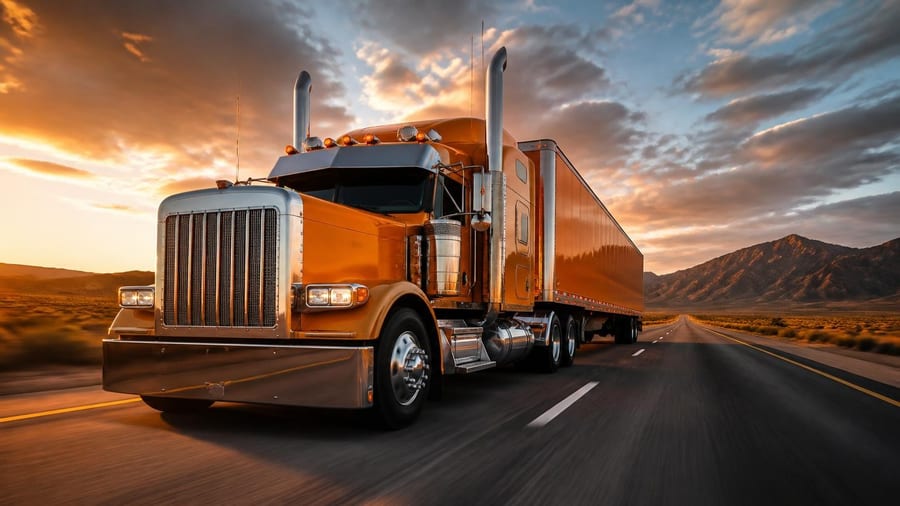
Long before electronic logging devices and speed limiters became standard, America's highways witnessed a phenomenon that would become trucking folklore. The left lane of Interstate 80 earned an unofficial name in the early 1970s: Monfort Lane. It wasn't a legal designation or a formal traffic rule—it was a tribute to the fastest commercial trucks ever to roar across the continent, hauling refrigerated beef from the Rocky Mountains to the East Coast at speeds that made passenger cars look slow.
The story begins not with technology or regulation, but with a simple business problem. Monfort of Colorado, a meat-packing operation based in Greeley, needed to deliver fresh beef to New York City markets 1,700 miles away before spoilage could set in. Traditional routes through Chicago's stockyards added time, cost, and logistical headaches. So the company made a radical decision: process the meat in Colorado, load it into refrigerated trailers, and race it directly to Hunts Point Market in the Bronx with minimal stops.
What emerged was a fleet of brightly painted rigs—vivid orange, yellow, and white—that became known as "Circus Wagons" for their eye-catching color schemes. But the paint was just the beginning. These trucks were engineered for one purpose: sustained high-speed interstate travel in an era when most big rigs struggled to maintain highway pace.
Engineering Speed Into Heavy Iron
Monfort's approach to trucking was unconventional. While competitors focused on fuel economy and payload maximization, Monfort prioritized speed and reliability. The company selected Kenworth W925 conventionals and later the sleek K100 cabover models, both known for their robust construction and willingness to accept heavy-duty powerplants.
Under the hoods of these rigs sat engines that were anything but ordinary. The most common was the Cummins NTC350, a naturally aspirated inline-six diesel producing 350 horsepower—a staggering figure for early-1970s trucking. Some drivers and mechanics from that era claim certain Monfort trucks ran even hotter setups: Detroit Diesel 8V-T1 two-stroke engines or legendary Caterpillar V8 diesels rumored to push 600 horsepower.
These numbers matter because the typical highway tractor of the period struggled to exceed 55 mph fully loaded. Monfort's rigs, by contrast, were reportedly capable of sustained speeds approaching 80 mph, even with a refrigerated trailer hooked up. In an industry where every hour saved meant fresher product and lower spoilage, this performance edge translated directly into competitive advantage.
To support the speed, each truck carried massive fuel tanks holding up to 300 gallons of diesel. The route from Greeley to New York was planned around a single refueling stop at a company-owned facility in Morris, Illinois. This minimized downtime and kept the trucks moving through the night, when traffic was lightest and speeds could be maintained.
The Human Element: Relay Drivers and Four-Hour Shifts
No truck, no matter how powerful, could maintain Monfort's grueling pace without equally committed drivers. The company employed a relay system that kept the trucks moving around the clock. Each rig carried two drivers working in four-hour shifts, allowing one to sleep in the bunk while the other held the wheel.
"You didn't just drive a Monfort truck—you lived in it for days at a time, pushing the machine and yourself to the edge of what was possible on an open highway."
This rotation meant that a Monfort truck never truly stopped except for fuel. While one driver rested, the other maintained highway speed, often holding the left lane for hours at a stretch. The relay system was exhausting, but it allowed the company to complete the cross-country haul in under 30 hours, an achievement that seemed impossible to competitors using traditional single-driver operations.
The drivers themselves became part of the legend. They developed a reputation for road discipline, predictability, and an unspoken highway code. When a Monfort rig approached in the rearview mirror, other truckers knew to move right. The Circus Wagons owned the left lane, and their bright colors made them impossible to miss from a mile back.
Interstate 80 and the Birth of a Nickname
Interstate 80 stretches more than 2,900 miles from San Francisco to Teaneck, New Jersey, passing through eleven states. For Monfort, the relevant stretch was the central and eastern corridor: Wyoming, Nebraska, Iowa, Illinois, Indiana, Ohio, Pennsylvania, and into the New York metro area. This route became the company's proving ground.
As Monfort's fleet grew and its reputation spread, truckers across the country began referring to the left lane on I-80 as Monfort Lane. The name stuck because it was descriptive and accurate. If you were traveling I-80 and saw a flash of orange and yellow streaking past, you knew what it was. The lane became synonymous with speed, efficiency, and a kind of outlaw professionalism that defined an era of American trucking before federal oversight tightened.
The phenomenon wasn't just about one company's trucks. Monfort Lane represented a broader culture in which drivers took pride in their rigs, pushed machines to their limits, and operated in a regulatory gray zone where speed limits were suggestions and enforcement was sparse. The 1970s were a golden age for independent truckers and company fleets willing to bend the rules in pursuit of profit and prestige.
The Decline of an Era
Monfort's high-speed experiment couldn't last forever. In 1974, Congress enacted a national 55 mph speed limit in response to the oil crisis, aiming to conserve fuel. Enforcement increased, and the wide-open days of 80 mph highway runs began to close. Speed limiters, electronic logging devices, and stricter safety regulations followed in subsequent decades, fundamentally changing the economics and culture of long-haul trucking.
Monfort itself evolved. The company was eventually acquired by ConAgra Foods in 1987, and the iconic Circus Wagons disappeared from the highways. Modern refrigerated trucking relies on just-in-time logistics, GPS tracking, and fuel-efficient engines that prioritize economy over raw speed. The romance of the road—drivers sleeping in shifts, racing against the clock with nothing but diesel and determination—has largely been replaced by data analytics and compliance software.
Yet the legend endures. Trucking forums, vintage rig shows, and oral histories keep the story of Monfort Lane alive. Collectors restore old Kenworth cabovers in the original orange-and-yellow livery, and retired drivers share tales of holding the throttle wide open across the Nebraska plains, watching the sun rise over Iowa cornfields from the left lane.
What Monfort Lane Teaches Us Today
The story of Monfort's speed fleet offers lessons beyond nostalgia. It illustrates how a company willing to invest in specialized equipment and operational innovation can dominate a niche market. It also highlights the tension between efficiency and regulation—a debate that continues as the trucking industry grapples with autonomous vehicles, electric powertrains, and environmental mandates.
For logistics professionals, Monfort's approach is a case study in vertical integration and control. By owning the processing facilities, the refueling infrastructure, and the trucks themselves, the company minimized dependencies and maximized speed. For truck enthusiasts, it's a reminder of an era when mechanical engineering and human skill combined to push boundaries in ways that software alone cannot replicate.
Monfort Lane may no longer exist as a physical reality on Interstate 80, but it survives as a symbol of ambition, ingenuity, and the restless American drive to go faster, farther, and harder than anyone thought possible. In an age of standardized logistics and algorithmic routing, that spirit remains worth remembering.
This article is intended for informational and historical purposes and does not constitute professional advice on trucking operations, highway safety, or regulatory compliance.