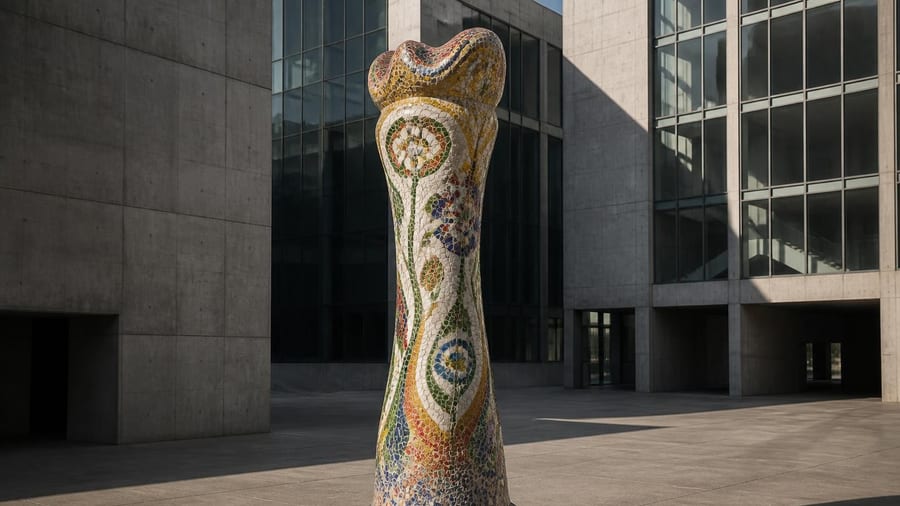
Antoni Gaudí's architectural legacy is instantly recognizable: the undulating facade of Casa Batlló, the forest-like columns of Sagrada Família, and the mosaicked benches of Park Güell have become defining symbols of Barcelona. Yet despite the visual power and technical innovation of his work, Gaudí's influence on global architecture remains surprisingly modest. While contemporaries such as Frank Lloyd Wright and Le Corbusier shaped modernist movements that spread across continents, Gaudí's radical aesthetic stayed largely confined to Catalonia. Understanding why requires examining the timing, philosophy, and practical constraints that limited his reach.
A Singular Vision Rooted in Place
Gaudí's architecture was deeply embedded in Catalan identity during a period of cultural renaissance known as the Renaixença. His use of regional materials—broken ceramic tiles (trencadís), local stone, and wrought iron—combined with references to Mediterranean nature created buildings that felt inseparable from their surroundings. This specificity gave his work an almost untranslatable quality. Unlike the International Style, which deliberately pursued universality through abstraction and industrial materials, Gaudí celebrated particularity.
His design process relied heavily on artisanal craftsmanship and improvisation. Rather than producing standardized blueprints that could be replicated elsewhere, Gaudí often worked directly with masons, carpenters, and ironworkers on-site, adjusting forms as construction progressed. This method produced buildings of extraordinary originality but offered no template for architectural education or reproduction. The Sagrada Família, begun in 1882 and still unfinished today, exemplifies both the ambition and the impracticality of his approach for a profession increasingly focused on speed and efficiency.
Timing and the Rise of Modernism
The early twentieth century witnessed a dramatic shift in architectural philosophy. The devastation of World War I accelerated demand for mass housing, standardization, and rationalized construction. Architects such as Walter Gropius and Ludwig Mies van der Rohe championed minimalism, prefabrication, and the elimination of ornament—principles diametrically opposed to Gaudí's elaborate, organic aesthetic.
Gaudí's most productive years coincided with the Art Nouveau movement, which flourished roughly from 1890 to 1910. Yet Art Nouveau itself fell out of favor by World War I, dismissed by modernists as decadent and impractical. Gaudí's work, even more individualistic than mainstream Art Nouveau, found itself doubly marginalized: too ornate for the modernists and too eccentric even for Art Nouveau purists. By the time of his death in 1926, architectural discourse had moved decisively toward functionalism.
The machine aesthetic that dominated mid-century architecture left little room for buildings that resembled living organisms more than engineered structures.
Geographic and Political Isolation
Barcelona's geographic position on the periphery of Europe limited Gaudí's exposure to international architectural circles. Unlike Paris, Berlin, or Vienna—cities that hosted major exhibitions and served as hubs for cross-pollination of ideas—Barcelona remained culturally provincial despite its economic vitality. Gaudí traveled infrequently and showed little interest in promoting his work beyond Catalonia.
Political factors compounded this isolation. The Spanish Civil War (1936-1939) and subsequent Franco dictatorship (1939-1975) suppressed Catalan culture and hindered international engagement. During these decades, architectural innovation centered on the United States, Scandinavia, and postwar reconstruction in Western Europe. Gaudí's work, associated with regional identity Franco sought to erase, was neglected in Spain itself and virtually unknown abroad.
- Limited international publications featuring his work until the 1960s
- Lack of completed buildings outside Catalonia to serve as ambassadors
- No formal school or movement to carry forward his methods
- Few architects trained directly under Gaudí to disseminate his techniques
The Challenge of Replication
Modern architecture relies on principles that can be taught, codified, and applied across different contexts. Gaudí's approach defied this logic. His use of catenary arches, hyperbolic paraboloids, and ruled surfaces demonstrated sophisticated structural understanding, yet these forms emerged from physical models—chains, weighted fabrics, and hand-sculpted plaster—rather than mathematical formulas architects elsewhere could easily adopt.
The economic barrier also proved significant. Gaudí's major commissions depended on wealthy patrons willing to fund decades-long projects with uncertain outcomes. Industrialist Eusebi Güell financed Park Güell and several other works, while donations have sustained Sagrada Família construction for more than a century. This patronage model was incompatible with the twentieth-century emphasis on commercial viability and public housing.
| Gaudí's Approach | Modernist Mainstream |
|---|---|
| Site-specific, artisanal | Universal, industrialized |
| Organic forms, ornament | Geometric abstraction, minimalism |
| Intuitive, model-based | Rationalized, blueprint-driven |
| Decades-long timelines | Rapid, cost-efficient construction |
A Late Renaissance and Digital Revival
Gaudí's reputation began its rehabilitation in the 1960s and 1970s as postmodern architects questioned modernist orthodoxy. Critics and historians reappraised his work as prescient rather than retrograde, noting his sophisticated engineering and environmental sensitivity. UNESCO designated several Gaudí buildings as World Heritage Sites in 1984, cementing his canonical status.
Paradoxically, contemporary digital design tools have made Gaudí's complex geometries more accessible. Parametric modeling software allows architects to analyze and generate forms similar to those Gaudí intuited through physical experimentation. Some contemporary practices cite him as inspiration for biomimetic design, though the connection remains conceptual rather than methodological. His influence today is more symbolic than stylistic—a reminder that architecture can embrace complexity, locality, and craft even in an age of global standardization.
Lessons From a Localized Legacy
Gaudí's limited global impact reveals tensions between artistic vision and professional practice. Architecture, unlike painting or sculpture, requires collaboration, capital, and compliance with building codes—factors that favor replicable methods over singular genius. His work also underscores how historical timing shapes legacy: innovations that arrive during a receptive cultural moment spread widely, while those that clash with prevailing values may wait generations for recognition.
For contemporary architects, Gaudí offers a case study in the costs and rewards of uncompromising originality. His buildings remain pilgrimage sites that generate millions in tourism revenue annually, yet his methods influenced few practitioners during his lifetime. Whether this represents failure or success depends on one's definition of architectural impact—immediate influence on the profession, or enduring power to inspire wonder.
This article provides historical and cultural analysis and does not constitute professional advice for architectural practice or preservation.