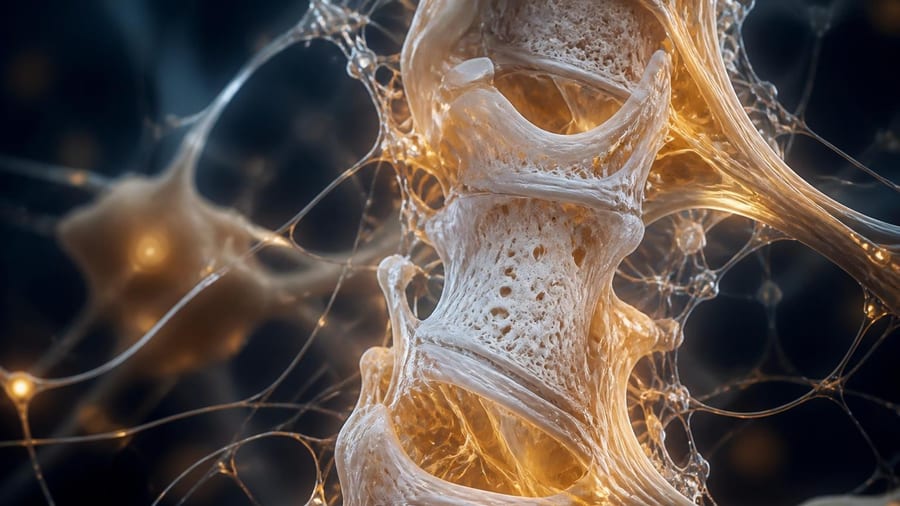
When most people picture the human skeleton, they imagine a static scaffold of white, lifeless material—something closer to the Halloween decorations than living tissue. Yet beneath the surface, your bones are humming with biological activity, orchestrating conversations with distant organs and fine-tuning everything from energy balance to immune function.
Researchers now understand that the skeleton operates as an endocrine organ, releasing hormone-like molecules that influence tissues far beyond the joints and marrow. This revelation has reshaped how medical science approaches bone health, revealing that skeletal strength is inseparable from metabolic wellness, brain function, and even reproductive health.
The Skeleton as a Signaling Hub
Until recently, textbooks described bone primarily as a reservoir for calcium and phosphorus, a framework for muscle attachment, and a protective cage for vital organs. While those roles remain true, the skeleton also manufactures and secretes at least a dozen signaling proteins that regulate processes throughout the body.
One of the most studied bone-derived hormones is osteocalcin, produced by osteoblasts—the cells responsible for building new bone tissue. Once osteocalcin enters the bloodstream, it travels to the pancreas, where it stimulates insulin secretion and improves the body's ability to use glucose. Animal studies have shown that mice engineered to lack osteocalcin develop insulin resistance and gain excess weight, underscoring the skeleton's role in metabolic regulation.
Osteocalcin also crosses the blood-brain barrier, where it appears to support memory and cognitive function. Research in rodents has demonstrated that older animals given osteocalcin supplements show improvements in spatial learning tasks, hinting at a direct skeletal influence on brain aging.
Bone is not a passive player—it actively shapes how we store energy, respond to stress, and even how our brains age.
How Mechanical Load Triggers Biological Responses
Your bones are remarkably sensitive to the forces applied to them. Each time you walk, jump, or lift a weight, the skeleton experiences tiny deformations. Specialized cells called osteocytes—which are embedded like sentries throughout the bone matrix—detect these mechanical strains and translate them into biochemical signals.
This process, known as mechanotransduction, prompts the release of molecules that either recruit bone-building osteoblasts or suppress bone-resorbing osteoclasts. The result is a tissue that strengthens precisely where stress is greatest and weakens where it is absent. This is why prolonged bed rest or extended missions in microgravity lead to measurable bone loss: without regular loading, the skeleton interprets the lack of demand as a signal to downsize.
- Weight-bearing exercise (walking, running, hiking) applies vertical forces that stimulate the legs and spine.
- Resistance training (lifting, resistance bands) creates targeted stress on specific bones and joints.
- High-impact activities (jumping, dancing) generate brief but powerful loads that trigger robust bone responses.
- Low-impact movement (swimming, cycling) supports cardiovascular health but provides limited skeletal benefit.
The skeleton's responsiveness to load explains why athletes in weight-bearing sports tend to have higher bone density than swimmers or cyclists of the same age and fitness level.
Bone Marrow and the Immune Connection
Deep inside many bones lies the marrow, a spongy tissue that serves as the birthplace for nearly all blood cells. Red marrow produces erythrocytes (red blood cells), leukocytes (white blood cells), and platelets, making the skeleton indispensable to oxygen transport, immune defense, and clotting.
Emerging research suggests that the bone marrow microenvironment—shaped by osteoblasts and other skeletal cells—plays a critical role in regulating immune cell development. Certain bone-derived signals help guide the maturation of B cells and T cells, the adaptive immune cells responsible for recognizing and neutralizing pathogens.
When bone remodeling is disrupted, as in osteoporosis or chronic inflammation, the marrow's ability to support healthy immune function may also suffer. This interplay hints at why individuals with severe bone disease sometimes experience immune dysregulation, though the mechanisms remain an active area of investigation.
Aging, Hormones, and the Tipping Point
Bone mass reaches its peak in the late twenties to early thirties. After that, the balance between bone formation and bone breakdown begins to shift. For women, the decline accelerates sharply after menopause, when estrogen levels drop. Estrogen inhibits osteoclast activity, so its absence allows bone resorption to outpace new bone formation.
Men experience a more gradual decline, driven by age-related reductions in testosterone and growth hormone. By age 70, both sexes have typically lost 20 to 30 percent of their peak bone mass, raising the risk of osteoporosis and fractures.
| Life Stage | Bone Activity | Key Influences |
|---|---|---|
| Childhood & Adolescence | Rapid growth, high formation rate | Growth hormone, nutrition, physical activity |
| Early Adulthood | Peak bone mass achieved | Sex hormones, calcium intake, exercise |
| Middle Age | Gradual loss begins | Declining hormones, lifestyle factors |
| Older Adulthood | Accelerated resorption | Menopause (women), sarcopenia, inflammation |
Maintaining bone health in later decades requires attention to nutrition (adequate calcium, vitamin D, and protein), physical activity (especially resistance and weight-bearing exercise), and fall prevention strategies to reduce fracture risk.
The Fracture Healing Symphony
When a bone breaks, the body launches a complex repair operation that mirrors the original process of bone formation. Within hours, a blood clot forms at the fracture site, creating a scaffold for new tissue. Immune cells rush in to clear debris, while stem cells migrate from the marrow and surrounding tissues.
Over the following weeks, these stem cells differentiate into chondrocytes (cartilage-forming cells) and osteoblasts. The cartilage framework, called a soft callus, gradually mineralizes into a hard callus of woven bone. Finally, osteoclasts and osteoblasts work together to remodel the callus into mature, lamellar bone that closely matches the original structure.
Fracture healing is a remarkable demonstration of the skeleton's regenerative capacity, but it depends on adequate blood supply, proper immobilization, and sufficient nutrients—particularly protein, calcium, and vitamin D.
Practical Takeaways for Skeletal Wellness
Understanding bone as a dynamic, communicative organ shifts the focus from passive protection to active maintenance. Here are evidence-based strategies to support skeletal health across the lifespan:
- Engage in weight-bearing and resistance exercise at least three times per week to stimulate bone formation.
- Ensure adequate intake of calcium (1,000–1,200 mg/day for adults) and vitamin D (600–800 IU/day, or more if deficient).
- Consume sufficient protein (0.8–1.0 g per kg body weight) to support bone matrix synthesis.
- Avoid excessive alcohol and smoking, both of which accelerate bone loss.
- Schedule bone density screening if you are over 50 or have risk factors for osteoporosis.
This information does not replace advice from a qualified healthcare professional. Consult your physician before starting any new exercise or supplement regimen, especially if you have existing bone or metabolic conditions.