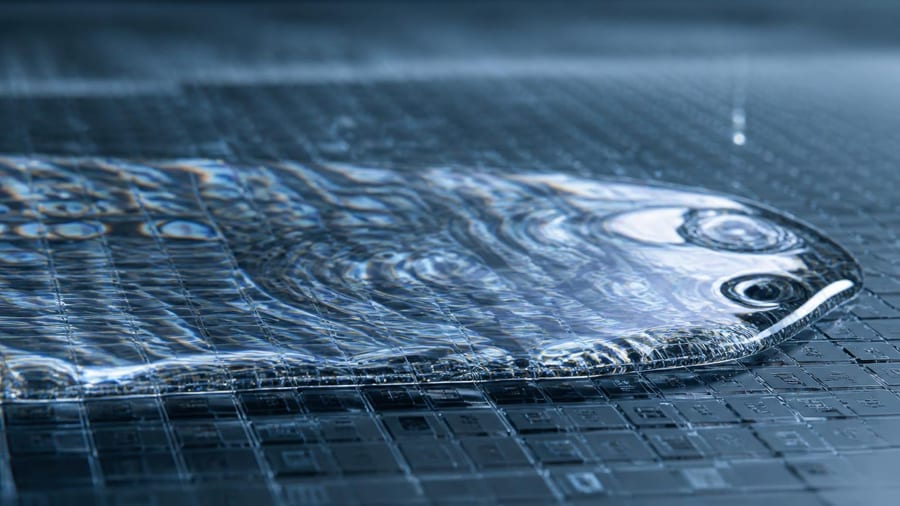
At scales measured in billionths of a meter, water behaves in ways that defy everyday intuition. When a nanoscale droplet lands on a surface that attracts water molecules—a hydrophilic substrate—the droplet doesn't simply sit as a rounded bead. Instead, it spreads into an astonishingly thin film, sometimes only a few molecular layers thick. Understanding why this spreading occurs has puzzled scientists for years, but new molecular simulations are finally illuminating the atomic choreography behind the phenomenon.
These findings hold practical stakes far beyond the laboratory. From anti-fog coatings on eyeglasses and windshields to the precise fluid channels inside lab-on-a-chip diagnostic devices, the way water interacts with surfaces at the nanoscale shapes technology that millions rely on daily. Researchers now have a clearer picture of the hydrogen bonding, surface energy, and thermodynamic forces that drive water's remarkable ability to wet and spread.
The Physics of Tiny Droplets
Classical theories of wetting, developed for macroscopic puddles and raindrops, assume that surface tension and contact angles fully describe how liquids spread. Those models work well at millimeter and centimeter scales, where gravity and bulk fluid properties dominate. But shrink the droplet to nanometer dimensions—roughly one ten-thousandth the width of a human hair—and the rules change.
At such scales, individual water molecules interact directly with atoms on the substrate surface. The balance between water-water hydrogen bonds and water-surface attractions becomes the dominant factor. On hydrophilic materials—such as clean silica, certain metal oxides, or treated glass—the surface offers favorable binding sites. Water molecules near the interface sacrifice some of their mutual hydrogen bonds to form new interactions with the substrate, releasing energy and driving the droplet to flatten.
Molecular dynamics simulations reveal that the first few layers of water adopt an ordered structure, almost ice-like in arrangement, as they maximize contact with the hydrophilic substrate.
This ordered interfacial layer reduces the system's free energy more effectively than maintaining a compact, rounded shape. Consequently, the droplet spreads laterally until the energetic cost of creating new surface area balances the gain from wetting the substrate.
Computational Tools Reveal Atomic Behavior
Observing water at the nanoscale in real time remains experimentally challenging. Electron microscopes can damage delicate liquid samples, and traditional optical methods lack the resolution to resolve individual molecular layers. That gap is where computational molecular dynamics shines.
Researchers construct virtual systems containing thousands to millions of atoms—water molecules, substrate atoms, and sometimes trace ions or surfactants—and then apply Newton's equations of motion under controlled temperature and pressure. The simulations track every atom's position and velocity over picoseconds and nanoseconds, generating detailed trajectories that reveal how droplets evolve from initial contact to equilibrium.
- High-performance computing clusters run simulations for days or weeks to accumulate sufficient data.
- Force fields—mathematical descriptions of atomic interactions—must be carefully calibrated to reproduce experimental wetting angles and surface tensions.
- Advanced algorithms handle long-range electrostatic forces and periodic boundary conditions, ensuring the virtual droplet behaves as it would in a real laboratory.
By analyzing these trajectories, scientists measure contact angles, density profiles perpendicular to the surface, and hydrogen-bond networks. The simulations confirm that on strongly hydrophilic surfaces, water nanodrops can spread to film thicknesses below 2 nanometers, with the first molecular layer showing pronounced ordering.
Implications for Coatings and Microfluidics
The insights from molecular simulations translate directly into engineering applications. Anti-fog coatings, for instance, rely on promoting uniform water spreading rather than allowing droplets to bead up and scatter light. By tailoring surface chemistry to maximize hydrophilicity, manufacturers can ensure that condensed moisture forms transparent films instead of vision-obscuring droplets.
In microfluidic devices—miniature platforms that manipulate picoliter volumes for blood tests, DNA sequencing, or chemical synthesis—channel walls often measure only micrometers across. At those scales, capillary forces dominate, and understanding nanoscale wetting determines whether fluids flow predictably or stall. Designing channel coatings that encourage thin, stable water films minimizes flow resistance and prevents unwanted droplet breakup.
| Application Domain | Role of Nanoscale Wetting | Performance Benefit |
|---|---|---|
| Anti-fog optics | Promotes continuous film over beads | Maintains optical clarity |
| Lab-on-a-chip | Ensures stable fluid transport | Improves diagnostic accuracy |
| Biomedical implants | Controls protein adsorption | Reduces immune response |
| Self-cleaning surfaces | Enables dirt removal by spreading water | Lowers maintenance costs |
Biomedical devices also benefit. Implants and sensors in contact with bodily fluids must manage protein adsorption, which depends on the interfacial water layer. A well-ordered hydration shell can shield a surface from unwanted biomolecule attachment, reducing inflammation and extending device lifespan.
Challenges in Modeling Real-World Complexity
Despite their power, molecular simulations face limitations. Real surfaces are rarely atomically smooth; they harbor defects, contaminants, and chemical heterogeneity. Simulating such complexity requires larger systems and longer run times, straining even cutting-edge supercomputers. Force fields, while sophisticated, remain approximations that may not capture quantum mechanical effects or charge transfer at interfaces.
Researchers address these challenges by combining simulations with experimental validation. Advanced techniques like atomic force microscopy and sum-frequency generation spectroscopy probe interfacial water structure, providing benchmarks to refine computational models. Iterative cycles of simulation and experiment gradually narrow uncertainties and build confidence in predictions.
Another frontier involves dynamic wetting—how droplets spread over time rather than simply reaching equilibrium. Spreading dynamics depend on viscosity, inertia, and molecular-scale friction, all of which vary with temperature and surface roughness. Capturing these transient phenomena demands temporal resolutions of femtoseconds and spatial resolutions of angstroms, pushing the boundaries of current algorithms.
Future Directions in Nanoscale Wetting Research
As computational power grows and algorithms improve, researchers aim to simulate ever-larger and more realistic systems. Machine learning is emerging as a tool to accelerate force-field development, training neural networks on quantum-mechanical data to predict atomic interactions with near-quantum accuracy at classical speed.
Another promising avenue explores mixed-wettability surfaces—substrates patterned with hydrophilic and hydrophobic regions at the nanoscale. Such patterns can guide droplet motion, enable controlled coalescence, or create barriers to spreading. Understanding how water nanodrops navigate these chemical landscapes will inform next-generation lab-on-a-chip devices and smart coatings.
Climate science also stands to gain. Cloud droplet formation on atmospheric aerosols—tiny particles that range from tens to hundreds of nanometers—depends critically on surface chemistry and nanoscale wetting. Improved models of how water condenses and spreads on salt, mineral, and organic aerosols will refine predictions of cloud albedo, precipitation, and climate feedbacks.
This information does not replace advice from a qualified professional in materials science, engineering, or related fields.