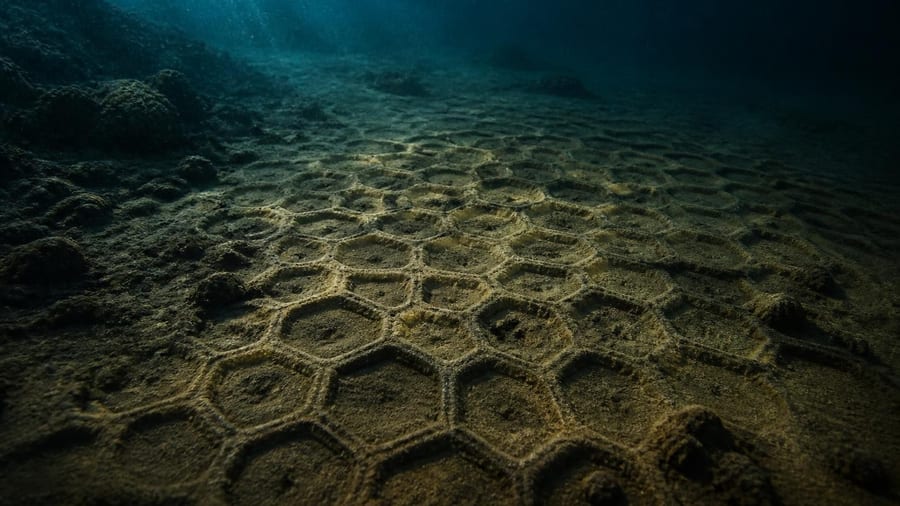
Deep beneath the Atlantic Ocean, submersibles have captured images of something extraordinary: near-perfect honeycomb patterns etched into the seafloor. These geometric imprints, known as Paleodictyon, have mystified marine biologists and paleontologists since their discovery in sedimentary rock layers more than a century and a half ago. The pattern appears with such precision that it seems almost artificial, yet its origins stretch back 500 million years through Earth's geological record.
What makes this phenomenon particularly baffling is that despite modern imaging technology, DNA analysis, and direct sampling expeditions, researchers still cannot identify what creates these structures. The mystery deepens when you consider that whatever leaves this distinctive trace has persisted across multiple mass extinction events, adapted to changing ocean chemistry, and continues to thrive in the lightless depths of today's oceans.
A Pattern That Transcends Time
The story begins in 1850 when Italian paleontologist Giuseppe Meneghini examined Eocene-era deposits and documented an unusual fossil. Unlike typical paleontological finds—bones, shells, or mineralized tissue—Meneghini was looking at an impression, a network of hexagonal chambers arranged in geometric precision. He named it Paleodictyon, meaning "ancient net."
Since then, identical or nearly identical patterns have surfaced in sedimentary formations worldwide. Alpine cliff faces preserve ancient examples. Oceanographic surveys have documented modern specimens at depths exceeding 3,500 meters in the Atlantic. The temporal range is staggering: these formations appear in rocks dating from the Cambrian period through to contemporary ocean floors, suggesting that whatever organism or process creates them has endured longer than most recognizable life forms on Earth.
This persistence through geological time places Paleodictyon in the category of living fossils—organisms that show minimal evolutionary change over vast periods. Yet unlike the coelacanth or horseshoe crab, we cannot definitively say what Paleodictyon actually is.
When Scientists Retrieved Empty Tunnels
The breakthrough moment seemed to arrive in the 1970s when deep-sea exploration vehicles surveying the Mid-Atlantic Ridge began photographing fresh examples of the honeycomb pattern on the abyssal plain. Here, finally, was an opportunity to examine living specimens rather than mineralized impressions.
Expeditions at the turn of the millennium successfully retrieved samples from depths around 11,500 feet. Researchers carefully extracted sections of seafloor containing the characteristic mesh of tunnels and chambers. The expectation was straightforward: examine the burrows, identify the inhabitant, solve the mystery.
Instead, every sample came back empty. No organisms—living or deceased—occupied the tunnels. More surprisingly, no DNA traces remained in the sediment lining the chambers. It was as if whatever created these elaborate structures had vanished without leaving molecular evidence behind. This absence of genetic material is highly unusual; even after an organism departs or dies, environmental DNA typically persists in sediment for extended periods.
The Geometry Problem
The precision of the hexagonal arrangement compounds the puzzle. Natural processes can produce geometric patterns—basalt columns form hexagons through cooling physics, and honeycombs emerge from bees optimizing space and material. But those processes involve either crystallization or deliberate architectural behavior by cognitively capable animals.
The hexagonal network appears too regular to be random burrowing, yet too widespread across time and geography to be coincidental or artificially created.
Each chamber typically measures between 5 and 15 millimeters in diameter, with walls of consistent thickness separating adjacent hexagons. The overall mesh can span several square meters on the ocean floor. If this represents animal behavior, it suggests either remarkable spatial planning or an innate biological template that produces consistent results across millions of generations.
Competing Hypotheses Reveal Deep-Sea Possibilities
Without physical specimens or genetic evidence, scientists must rely on the trace fossil itself to infer the creator's identity. Several competing theories have emerged, each highlighting different aspects of deep-sea biology.
- Worm-like burrowers: Marine worms create elaborate tunnel systems for protection and feeding. A specialized species might excavate honeycomb patterns to maximize surface area for trapping organic particles drifting down from upper ocean layers. The geometry could represent an evolutionary optimization for filter-feeding efficiency.
- Single-celled architects: Xenophyophores, giant single-celled organisms found in deep-sea environments, construct intricate structures from sediment and agglutinated particles. Some species can exceed 10 centimeters in diameter despite being unicellular. Paleodictyon could represent either their dwelling or the impression left after their bodies decompose.
- Bacterial farming: One hypothesis suggests the pattern represents an ancient form of agriculture, where an unknown organism cultivates bacterial colonies in organized chambers, harvesting them systematically for nutrition. This would explain the geometric precision and the apparent absence of the farmer when samples are retrieved—disturbing the structure might cause the organism to abandon it.
- Microbial mats: Some researchers propose that microbial communities themselves create the pattern through chemotactic behavior, though this theory struggles to explain the consistency across different ocean basins and geological periods.
Why This Mystery Matters Beyond Curiosity
Understanding Paleodictyon has implications beyond solving a paleontological puzzle. The deep sea remains one of Earth's least explored environments, with estimates suggesting we have investigated less than 20% of the ocean floor in any detail. Organisms capable of persisting for half a billion years likely possess remarkable adaptive mechanisms.
If Paleodictyon represents a feeding strategy, it could inform our understanding of how deep-sea ecosystems process organic material. If it's architectural behavior by single-celled organisms, it challenges assumptions about the relationship between complexity and multicellularity. The structure's persistence through major climate shifts and ocean chemistry changes might offer insights into resilience in the face of environmental upheaval.
| Characteristic | Ancient Fossils | Modern Specimens |
|---|---|---|
| Location | Alpine sedimentary rock | Atlantic abyssal plain |
| Depth (paleo) | Deep marine environments | 3,500+ meters |
| Age range | 500-40 million years | Contemporary |
| Hexagon size | 5-15 mm typical | 5-15 mm typical |
| DNA evidence | N/A (fossilized) | None detected |
The Search Continues in Darkness
Recent technological advances offer new approaches to the Paleodictyon mystery. Autonomous underwater vehicles can now survey larger areas of the abyssal plain without disturbing delicate structures. Environmental DNA sampling techniques have become more sensitive, potentially detecting trace genetic material missed by earlier methods. High-resolution imaging allows researchers to study the three-dimensional structure of the burrows in unprecedented detail.
Some marine biologists have proposed long-term monitoring stations positioned near known Paleodictyon sites, using time-lapse photography to potentially capture the creator in action. Others advocate for sediment core sampling around the structures to search for chemical signatures that might indicate metabolic processes.
The hexagonal mystery continues to attract interdisciplinary attention, bringing together paleontologists, marine biologists, geologists, and even mathematicians interested in natural pattern formation. Each expedition to the deep sea offers the possibility of finally identifying the architect behind these ancient nets.
This information does not replace advice from qualified marine biologists or paleontologists conducting research in this field.