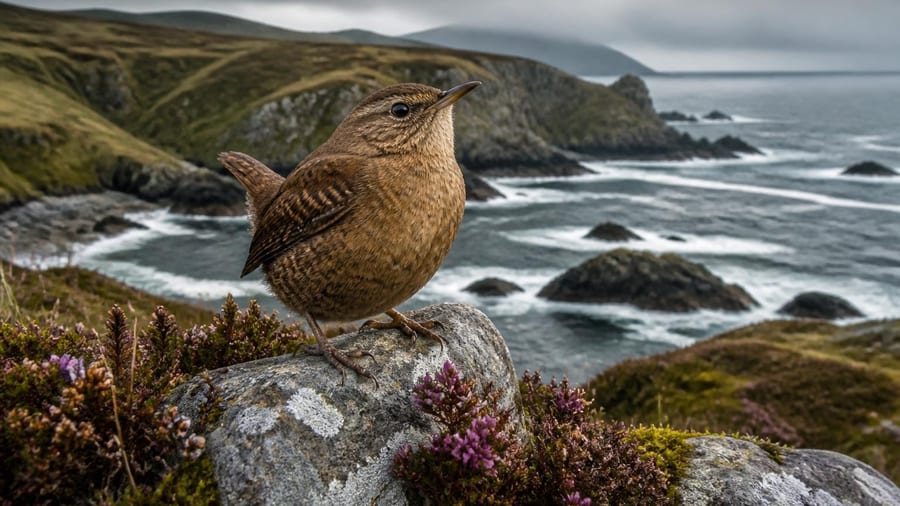
Evolution doesn't always unfold over millions of years. Sometimes, it happens fast enough for scientists to witness the transformation in real time. On a handful of remote Scottish islands, tiny wrens have been quietly rewriting the rulebook on body size, growing so large that they may soon qualify as entirely new species. The discovery offers a rare window into how isolation reshapes life in ways both dramatic and measurable.
Researchers from the University of Birmingham studied four distinct wren populations living on the Shetland Islands, Fair Isle, the Outer Hebrides, and St Kilda. These archipelagos, scattered across the North Atlantic, are harsh environments marked by strong winds, rocky terrain, and limited predators. Despite sharing similar climates, each island group has nurtured wrens that differ strikingly from their mainland cousins—and from one another.
Island Gigantism in Action
The phenomenon driving these changes is called island gigantism, a well-documented evolutionary pattern in which animals isolated on islands evolve larger body sizes over successive generations. Classic examples include the giant tortoises of the Galápagos and the extinct dodo of Mauritius. But birds rarely show such extreme size shifts, making the Scottish wrens an exceptional case.
A typical wren from England weighs between 7 and 10 grams. By contrast, wrens on St Kilda—an archipelago 40 miles west of Scotland's Outer Hebrides—tip the scales at 13 to 16 grams. The largest individuals are more than twice the mass of the smallest mainland birds. According to the research team, this places the St Kilda wren among the top 25% of recorded bird gigantism cases worldwide.
"We found that all four Scottish wren subspecies are genetically distinct from the wrens of mainland Britain, with the wrens of Shetland and St Kilda being especially distinct in both appearance and song."
The Shetland wren also shows significant size increases, though not quite as dramatic as St Kilda's. Meanwhile, wrens on Fair Isle and the Outer Hebrides occupy an intermediate zone, larger than mainland birds but smaller than their Shetland and St Kilda relatives.
Why Islands Favor Larger Bodies
Several evolutionary pressures may explain why island wrens have grown so large. One leading theory centers on the absence of predators. Mainland wrens face constant threats from foxes, weasels, and birds of prey. On isolated islands, many of these predators never arrived, removing the evolutionary premium on small, quick-to-hide body plans.
Another factor is resource availability. Island ecosystems often support fewer bird species, reducing competition for food. Larger bodies can store more fat, a critical advantage during harsh winters when storms cut off food supplies for days or weeks. Wrens with extra reserves survive longer, passing their genes to the next generation.
Climate also plays a role. Larger animals lose heat more slowly than smaller ones, a principle known as Bergmann's rule. In the cold, wind-swept environment of the Scottish islands, a bigger body may help wrens conserve warmth and reduce energy expenditure.
Genetic Isolation Accelerates Change
The research team used whole genome sequencing to map the genetic distance between island and mainland populations. The results confirmed that each island group has remained reproductively isolated for hundreds or thousands of generations. Gene flow between islands and the mainland is minimal, allowing evolutionary changes to accumulate without being diluted by interbreeding.
Shetland and St Kilda wrens show the highest levels of genetic differentiation. Their songs, too, have diverged, with distinct pitch patterns and note structures that mainland wrens don't recognize. In the bird world, song serves as both a mating call and a territorial signal. When populations stop understanding each other's songs, they stop interbreeding—a hallmark of speciation.
Are New Species Emerging?
The genetic and physical differences raise a tantalizing question: are these island wrens on the verge of becoming separate species? Speciation is a gradual process without a clear finish line, but several key markers suggest these populations are well along the path.
- Genetic distinctiveness: Island wrens show DNA signatures that differ significantly from mainland birds.
- Reproductive isolation: Little or no interbreeding occurs between island and mainland populations.
- Morphological divergence: Island birds are measurably larger, with different plumage and body proportions.
- Behavioral differences: Songs and calls have evolved to the point of mutual unintelligibility.
If isolation continues for another few thousand generations, scientists predict that island wrens will meet the formal criteria for new species. The Scottish islands could then claim credit for producing not one but multiple endemic bird species—a remarkable outcome for such a small geographic area.
Lessons from a Living Laboratory
The Scottish wrens offer more than a curiosity. They provide a real-time case study in how evolution responds to environmental change. Islands act as natural laboratories, where populations face distinct pressures and can't easily mix with outside gene pools. The results are evolutionary experiments played out in fast-forward.
Similar patterns have been documented in other species. Darwin's finches in the Galápagos, for instance, evolved different beak shapes in response to available food sources on different islands. Hawaiian honeycreepers diversified into dozens of species, each adapted to specific flowers and insects. The Scottish wrens fit neatly into this tradition, demonstrating that evolution doesn't require tropical isolation or millions of years to produce dramatic results.
| Location | Average Weight (grams) | Genetic Isolation |
|---|---|---|
| Mainland Britain | 7–10 | Low |
| Fair Isle | 10–12 | Moderate |
| Outer Hebrides | 11–13 | Moderate |
| Shetland | 12–14 | High |
| St Kilda | 13–16 | Very High |
Conservation Implications
Understanding island evolution carries practical weight. Island populations are inherently vulnerable. Small populations face higher risks of inbreeding, genetic drift, and local extinction. Climate change, invasive species, and human activity all pose threats to these isolated communities.
St Kilda, for instance, was evacuated of its human population in 1930 and is now managed as a nature reserve. The wrens there thrive in the absence of introduced predators like rats and cats. But other Scottish islands face different pressures. Development, tourism, and shipping traffic can disturb nesting sites or introduce non-native species that outcompete native birds.
Conservation efforts must recognize that island wrens aren't simply smaller versions of mainland birds. They represent unique evolutionary lineages with distinct genetic heritage. Protecting them means safeguarding not just individuals but entire evolutionary trajectories.
This information does not replace advice from a qualified conservation biologist or ornithologist.