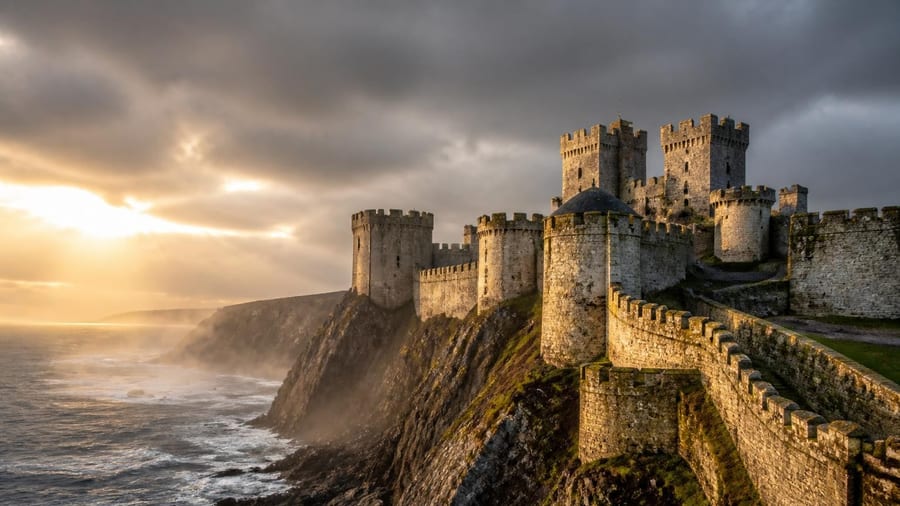
The architectural wonders of medieval Europe have long captured imaginations, but few realize just how directly these stone sentinels influenced modern fantasy literature. When George R.R. Martin crafted his sprawling world, he drew heavily from the continent's most dramatic fortifications, transforming centuries-old strongholds into the backdrop for dynastic struggles and legendary battles.
Across Europe, seven remarkable castles stand as testament to this creative exchange between history and fiction. Each fortress tells its own story of power, defense, and survival—narratives that echo through the pages of epic fantasy. From clifftop monasteries to riverside châteaux, these structures offer travelers a tangible connection to the worlds they've explored in books and on screen.
A French Château at the Water's Edge
The Loire Valley's Château de Chenonceau spans the River Cher with an elegance that belies its strategic past. Built in the 16th century on the foundations of an older mill, the château features a distinctive arched gallery that stretches across the water like a stone bridge. This architectural element creates a visual effect remarkably similar to the fictional seat of House Tully.
The structure's unique design served both aesthetic and practical purposes throughout its history. The medieval keep, surrounded by protective moats, represents the only surviving fragment of the original fortification. Over three centuries of expansion, successive owners transformed the military outpost into one of France's most photographed landmarks. The château's riverside position, while beautiful, also provided natural defenses that medieval architects valued highly.
Monasteries Suspended in the Sky
In central Greece, the Meteora Monasteries occupy a landscape that seems almost impossible. Byzantine monks began constructing these religious sanctuaries atop towering rock pillars in the 14th century, seeking isolation and spiritual elevation. The Greek name "Meteora" translates to "suspended in the air," a description that remains accurate today.
The clifftop sanctuaries of Meteora represent one of humanity's most extraordinary architectural achievements, combining faith with engineering ingenuity to create structures that defy conventional gravity.
Access to these monasteries originally required climbing removable ladders or being hauled up in nets—methods that provided excellent security against unwanted visitors. Of the 24 monasteries originally built, six remain active today and welcome visitors willing to climb the carved stone steps. The dramatic vertical geography mirrors fictional eyries where noble families sought refuge in impregnable heights.
German Strongholds on Sacred Mountains
Hohenzollern Castle crowns Mount Hohenzollern in southwestern Germany, its towers rising from the forested peak like a crown. The current structure, completed in the mid-19th century, represents the third iteration of fortifications on this site. The original fortress dates to the 1200s, though it was largely destroyed and rebuilt twice before achieving its present palatial form.
The castle served as the ancestral seat of the Hohenzollern dynasty, which eventually provided both German emperors and Prussian kings. Unlike many defensive fortresses that prioritized function over form, this reconstruction balanced military architecture with residential luxury. The chapel contains stunning stained glass, while the treasury houses artifacts from Prussian history, including the crown of Wilhelm II.
Architectural Features That Tell Stories
Key elements that distinguish Hohenzollern Castle include:
- Neo-Gothic spires and battlements designed for visual impact
- A commanding hilltop position at 2,805 feet elevation
- Extensive fortification walls with bastions and gates
- Interior chambers that blend medieval aesthetics with 19th-century comfort
Spanish Fortresses in Rugged Terrain
Spain's Castle of Zafra perches atop a rocky outcrop in Guadalajara province, its isolated tower silhouetted against the sky. Built in the late 12th or early 13th century, this fortress changed hands among Spanish noble families for generations. Its remote location and difficult access made it a formidable defensive position during medieval conflicts.
The castle's strategic value lay in its elevation and visibility across the surrounding plains. Garrison soldiers could spot approaching forces from miles away, while attackers faced the daunting challenge of scaling exposed rock faces. After centuries of use, the structure fell into disrepair before recent restoration efforts began preserving what remains of its medieval stonework.
The Castle of Trujillo, also in Spain, offers a different architectural profile. This fortification dominates the town of Trujillo in Extremadura, its Arabic origins evident in the defensive design. The castle's walls enclose a large courtyard, and its towers provide panoramic views across the region where conquistadors once called home.
Croatian Fortifications Above the Adriatic
The Lovrjenac Fortress stands on a cliff 120 feet above the Adriatic Sea, guarding the western approach to Dubrovnik. Built in the 11th century, this fortress played a crucial role in maintaining the independence of the Dubrovnik Republic. Its massive walls, reaching up to 12 feet thick on the seaward side, withstood numerous sieges and naval bombardments.
The fortress's position allowed defenders to control maritime traffic and protect the harbor from enemy fleets. Today, visitors climb the steep stone steps to explore its ramparts and courtyards, which offer dramatic views of both the medieval city and the azure waters below. The fortress regularly hosts cultural performances, its natural acoustics and dramatic setting creating an unforgettable venue.
Scottish Keeps in Highland Territory
Doune Castle in central Scotland represents classic medieval military architecture. Built in the late 14th century for the Duke of Albany, the castle features a formidable keep with thick stone walls and strategic defensive positions. Unlike many later castles that evolved into residences, Doune retains its original martial character.
The castle's layout follows a courtyard design, with the great hall occupying a prominent position. Its well-preserved state allows visitors to experience medieval spatial arrangements, from the kitchen's vaulted ceiling to the lord's private chambers. The castle's imposing gatehouse and flanking towers created overlapping fields of fire, making frontal assault nearly impossible.
Visiting These Historic Sites
| Castle | Country | Century Built | Key Feature |
|---|---|---|---|
| Chenonceau | France | 16th | Bridge gallery |
| Meteora | Greece | 14th | Clifftop position |
| Hohenzollern | Germany | 13th (rebuilt 19th) | Mountain summit |
| Lovrjenac | Croatia | 11th | Coastal fortification |
The Enduring Appeal of Medieval Architecture
These fortresses continue to attract millions of visitors annually, drawn by both their historical significance and their cultural resonance. The intersection of real medieval architecture with fantasy storytelling has created new appreciation for preservation efforts. Many of these sites face ongoing challenges balancing tourism demands with conservation needs.
European castle tourism generates significant revenue for local economies while funding restoration projects. Château de Chenonceau alone welcomes over 850,000 visitors each year, making it one of France's most visited historic sites after Versailles. The economic impact extends beyond admission fees, supporting hotels, restaurants, and cultural programs throughout surrounding regions.
Understanding these castles' authentic histories enriches the experience of exploring them. Each stone tells a story of the people who built, defended, and lived within these walls—stories that inspired the fictional worlds we've come to love. The next time fantasy literature transports readers to imaginary strongholds, they'll recognize the very real architectural heritage that made those visions possible.
This article provides historical and cultural information about architectural sites. It does not constitute professional travel advice or replace guidance from qualified tour operators and travel professionals.