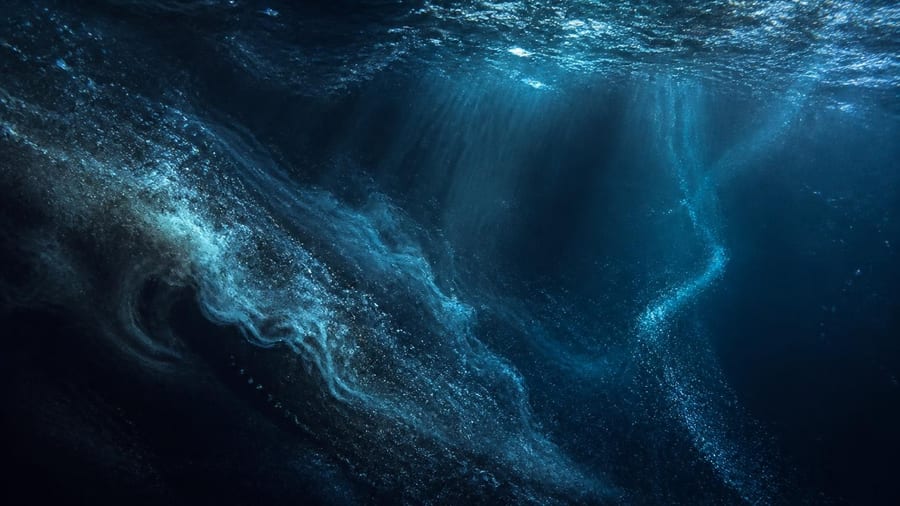
Deep beneath the Atlantic Ocean's surface, a massive conveyor belt of water silently shapes the climate of continents thousands of miles apart. This system, known as the Atlantic Meridional Overturning Circulation (AMOC), moves warm tropical waters northward toward Greenland, where they cool, sink to depths of nearly 5,000 meters, and return southward along the ocean floor. The entire process redistributes heat and salt across the Atlantic basin on a scale that affects weather patterns from Europe to Africa to North America.
Scientists have documented a troubling trend: AMOC appears to be weakening. Multiple research teams have observed signals in ocean sediments, temperature records, and computer models that suggest the circulation is slowing. If this trend continues or accelerates, the consequences could be severe. Northern Europe might face significantly colder winters even as global temperatures rise. Monsoon patterns in tropical regions could shift dramatically. Sea levels along the eastern United States could rise suddenly by several feet, flooding coastal cities with little warning.
Yet despite these stakes, AMOC struggles to hold public attention. News cycles move on. Climate conversations return to more familiar subjects: melting glaciers, intensifying hurricanes, record-breaking heat waves. The problem isn't a lack of scientific evidence or urgency. The problem is that AMOC operates in a realm almost impossible for most people to visualize.
Why invisible threats fail to capture attention
Climate journalism has evolved a visual vocabulary over decades. Burning forests provide dramatic footage. Calving icebergs create spectacular images. Polar bears stranded on shrinking ice floes have become symbolic shorthand for a warming planet. These visuals serve as proxies for complex systems that would otherwise remain abstract, translating scientific data into emotionally resonant imagery that editors can publish and audiences can immediately grasp.
AMOC offers none of these advantages. The circulation exists entirely underwater, moving at speeds measured in centimeters per second across distances spanning hundreds of kilometers. No photographer can capture it in action. No satellite can photograph it directly. The surface of the Atlantic reveals almost nothing about the titanic processes unfolding in the depths below.
Researchers must reconstruct AMOC's behavior from indirect evidence: chemical signatures preserved in ancient coral skeletons, sediment layers accumulating on the ocean floor, and temperature measurements collected by instruments moored in the darkness miles below the surface.
This evidence gets translated into computer models that can animate the circulation in three dimensions, but these scientific visualizations—designed for peer review and analysis—rarely translate into compelling news imagery. A multicolored diagram of ocean currents cannot compete with a photograph of a wildfire consuming a forest or floodwaters surging through city streets.
The visual filter in climate coverage
Consider how another oceanic phenomenon achieved widespread recognition despite similar challenges. The Great Pacific Garbage Patch exists as a diffuse soup of microplastics spread across millions of square kilometers of ocean. At sea level, most of it remains invisible—no floating island of trash, just tiny particles suspended throughout the water column.
Yet the garbage patch maintains a steady presence in news coverage. Why? Because it has visual proxies that news organizations can deploy. Photographers capture plastic bottles washing onto beaches. Documentary crews film nets and debris pulled from the ocean. Endurance swimmers undertake publicized journeys through the affected area, creating a human narrative around an otherwise abstract environmental problem. These images aren't technically accurate representations of the garbage patch itself, but they provide something tangible that audiences can see and understand.
AMOC lacks equivalent proxies. There are no plastic bottles to photograph, no visible debris field, no convenient stand-in that cameras can capture. The system operates on timescales of centuries and spatial scales of ocean basins—dimensions that resist the visual compression required for news imagery.
How scientists track an invisible giant
Oceanographers have developed sophisticated methods to monitor AMOC's behavior. Arrays of instruments called moorings sit anchored to the ocean floor at strategic locations, recording temperature, salinity, and current velocity around the clock. The RAPID array, deployed across the Atlantic at 26 degrees north latitude since 2004, provides continuous measurements that scientists use to calculate the circulation's strength.
Other evidence comes from paleoclimate records. Researchers analyze coral skeletons that grew centuries ago, reading chemical ratios locked into the calcium carbonate structure like tree rings. These ratios reveal information about past water temperatures and circulation patterns. Sediment cores drilled from the ocean floor preserve similar records, with each layer representing a slice of time when particles settled from the water column above.
- Temperature and salinity sensors deployed on moored arrays across the Atlantic basin
- Chemical analysis of coral skeletons that record past ocean conditions
- Sediment cores containing layered records of historical circulation patterns
- Satellite measurements of sea surface height and temperature that hint at deeper processes
- Computer models that synthesize disparate data into comprehensive reconstructions
All of this generates data—vast quantities of it—but none of it produces the kind of arresting visual that helps a story break through the noise of modern media.
Consequences that demand attention
The potential impacts of AMOC weakening or collapse extend far beyond oceanography. European agriculture depends on the relatively mild winters that AMOC currently provides by transporting tropical heat northward. Cities like London and Dublin sit at latitudes comparable to frigid parts of Canada but enjoy much warmer climates thanks to this heat transport. A significant slowdown could bring fundamentally different weather patterns to hundreds of millions of people.
| Region | Potential Impact |
|---|---|
| Northwestern Europe | Colder winters, altered precipitation patterns |
| US East Coast | Rapid sea level rise of several feet |
| West Africa | Shifts in monsoon timing and intensity |
| Amazon Basin | Changes in rainfall affecting forest ecosystems |
In the United States, AMOC slowdown could trigger sudden sea level increases along the Atlantic coast. When the circulation weakens, it no longer pulls water away from the western edge of the ocean basin as effectively. The result is a rapid rise in coastal water levels—potentially 20 inches or more in a matter of years—that would overwhelm existing flood defenses in cities from Boston to Miami.
These scenarios aren't speculative fiction. They represent the collective assessment of multiple research teams studying AMOC through different methods. The uncertainty lies not in whether impacts would occur, but in timing and magnitude. Some scientists project more gradual changes over coming decades. Others warn that tipping points could trigger faster transitions. All agree that continued weakening poses serious risks.
Making the invisible visible
Communicating about AMOC requires finding new approaches that work within journalism's visual constraints while conveying the system's significance. Some researchers have collaborated with data visualization specialists to create animations showing how heat moves through the Atlantic. Others have worked with documentary filmmakers to build narratives around the scientific detective work of reconstructing circulation history.
The challenge extends beyond mere illustration. It requires helping audiences develop intuition about systems that operate on scales removed from daily experience. Most people have never been 5,000 meters underwater. Few have direct experience with ocean currents beyond swimming in surf. Building understanding requires analogies, comparisons, and creative explanations that connect the unfamiliar to something concrete.
Perhaps AMOC's greatest communications challenge is that it demands attention for something that hasn't catastrophically failed yet. The system still functions. The consequences remain largely future-tense. In a media environment saturated with present-tense crises, sustaining focus on a slow-motion threat with no compelling imagery becomes extraordinarily difficult.
This information does not replace advice from qualified climate scientists, oceanographers, or other professionals. Readers concerned about climate impacts in their region should consult authoritative sources and local experts for guidance.