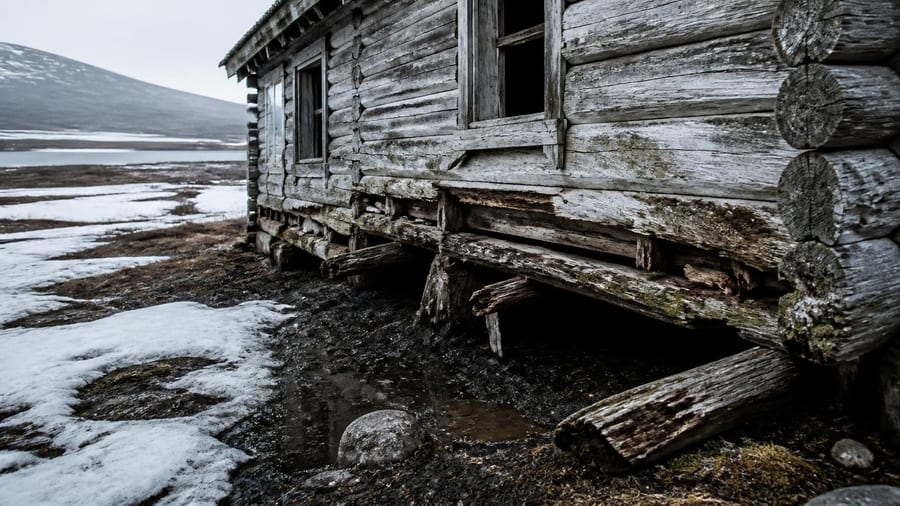
Historic wooden buildings across the Arctic circle face an unprecedented triple threat. Rising temperatures accelerate microbial decay, permafrost thaw destabilizes foundations, and growing tourist interest increases wear on fragile structures. From Alaska to Greenland, Scandinavia to Siberia, organizations and communities are racing to document and protect architectural treasures that hold irreplaceable cultural knowledge.
These structures—trading posts, mission churches, Indigenous storehouses, early research stations—were engineered for a climate that no longer exists. Many stand on pilings sunk into ground once frozen year-round. As that permafrost degrades, buildings tilt, crack, and collapse. Wood that stayed stable at sub-zero temperatures now cycles through freeze-thaw events that splinter timbers and invite fungal invasion.
Climate Shifts Rewrite Preservation Calculus
Traditional conservation methods assumed cold, dry conditions would naturally inhibit biological decay. That assumption no longer holds. Average winter temperatures in parts of Alaska and northern Canada have risen by 6°F since the mid-20th century, according to federal climate assessments. Longer summers with increased precipitation create ideal conditions for wood-rotting fungi and insect borers previously limited by harsh cold.
Preservationists now confront scenarios their predecessors never imagined: log cabins sagging as the ground beneath them transforms from solid ice to saturated mud, roof beams colonized by species moving poleward with warming trends, and entire communities of heritage structures at risk within a single generation. Standard treatments—chemical preservatives, controlled humidity, structural reinforcement—must be adapted for remote locations with short working seasons and logistical constraints.
The irony is that the very cold that helped preserve these buildings for a century is disappearing, and we're left trying to protect them in an environment they were never designed to endure.
Rot and Decay Accelerate in Warming Conditions
Wood degradation in the Arctic follows predictable biological pathways, but warming accelerates every stage. Brown rot fungi break down cellulose, leaving wood brittle and crumbly. White rot fungi attack lignin, causing structural collapse. Both thrive in the moisture-rich conditions created by melting permafrost, extended thaw seasons, and increased rainfall.
Insect damage compounds the problem. Bark beetles, carpenter ants, and wood-boring larvae expand their ranges northward as winter cold snaps become less lethal. A single mild winter can allow populations to explode, compromising buildings that survived decades of harsh conditions. Detection is difficult in remote areas visited only seasonally, meaning infestations often reach advanced stages before discovery.
Preservation teams now employ innovative monitoring techniques:
- Moisture meters and thermal imaging to detect hidden water accumulation
- Fungal DNA sampling to identify decay organisms before visible damage appears
- Structural sensors transmitting real-time stability data via satellite
- Drone surveys documenting exterior condition changes between site visits
These tools help prioritize intervention, but they cannot reverse fundamental climate-driven trends. Some structures may require relocation to more stable ground or complete disassembly and reconstruction—expensive, disruptive measures that communities often resist for cultural and spiritual reasons.
Tourism Pressures Complicate Conservation
Arctic tourism has grown dramatically over the past two decades, bringing welcome economic opportunities but also physical stress to fragile heritage sites. Visitors drawn by social media imagery and bucket-list ambitions generate foot traffic, vibration, moisture infiltration from wet clothing, and sometimes unauthorized alterations or souvenir-taking.
Small communities lack resources to implement comprehensive visitor management. A historic trading post might see a few dozen visitors annually for decades, then suddenly host hundreds as cruise ships add Arctic itineraries. Wooden floors wear, door frames loosen, and decades of stable climate equilibrium inside buildings is disrupted by constant opening and closing.
Balancing preservation with access poses ethical and practical dilemmas. Restricting visitation protects structures but may reduce local income and disconnect younger generations from heritage. Allowing unrestricted access accelerates deterioration. Successful models typically involve:
- Guided-only entry with group size limits
- Protective walkways and barriers around vulnerable elements
- Replica structures or interpretive centers to absorb visitor impact
- Revenue-sharing agreements funding conservation work
Some sites have adopted seasonal closures during the most vulnerable periods—spring thaw when foundations are unstable, or late summer when insect activity peaks. Digital documentation, including 3D laser scanning and virtual reality experiences, offers alternative ways to engage global audiences without physical presence.
Collaborative Strategies and Funding Challenges
Effective preservation requires coordination across tribal governments, national agencies, universities, and international heritage organizations. The Arctic Council, a forum of eight Arctic nations, has elevated cultural heritage protection within its environmental agenda, though funding remains fragmented and competitive.
| Challenge | Approach | Status |
|---|---|---|
| Remote access | Summer-only conservation crews | Limits intervention window |
| Material sourcing | Reclaim wood from collapsed structures | Variable quality, limited supply |
| Local expertise | Training programs for community members | Growing but underfunded |
| Climate adaptation | Experimental treatments, foundation systems | Promising early results |
Federal programs such as the National Park Service's Historic Preservation Fund support some Arctic projects, but competition is fierce and many sites fall outside protected areas. Private philanthropy and academic research grants fill gaps, yet multiyear commitments remain rare. Indigenous communities often bear primary stewardship responsibility with minimal external support, despite the broader cultural value these structures represent.
The Path Forward
Preserving Arctic wooden heritage demands recognition that traditional conservation alone cannot succeed in a rapidly changing environment. Adaptation strategies must incorporate climate projections, community priorities, and realistic assessments of what can be saved versus what must be documented before loss.
Emerging priorities include:
- Accelerated documentation using photogrammetry and material sampling before structures become too degraded
- Development of cold-climate wood treatments compatible with historic materials
- Creation of regional conservation centers reducing mobilization costs
- Integration of traditional ecological knowledge with scientific conservation methods
- Advocacy for dedicated Arctic heritage funding streams at national and international levels
Some structures will be lost. That reality forces difficult conversations about triage—which buildings merit intensive intervention, which can be stabilized but not fully restored, and which should be documented and allowed to return to the landscape. Each decision carries cultural weight, particularly for Indigenous communities whose identity and continuity are intertwined with these physical places.
This information does not replace advice from qualified historic preservation, structural engineering, or cultural heritage professionals. Specific conservation decisions should involve experts with Arctic building experience and community consultation.