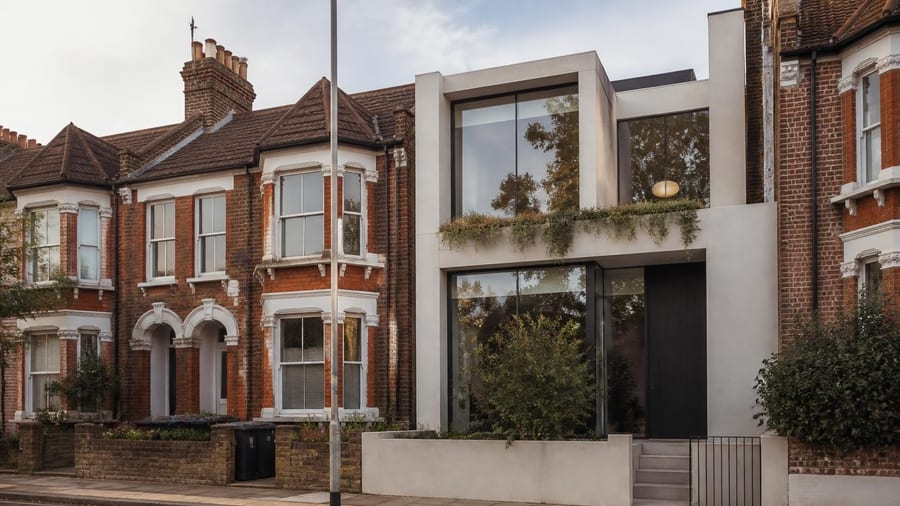
Across the United Kingdom, a new generation of residential architecture is challenging the notion that contemporary design must clash with historic streetscapes. From London's Victorian terraces to the Cotswolds' limestone villages, a handful of standout homes demonstrate how innovative architects can honor context while pushing aesthetic boundaries. These six projects prove that modern homes can coexist with—and even enhance—their traditional neighbors through thoughtful material choices, scale sensitivity, and creative reinterpretation of local building typologies.
The tension between preservation and progress has long defined British planning debates. Yet recent award-winning projects show that contemporary residential design need not mimic pastiche Georgian facades or Tudor half-timbering to earn community acceptance. Instead, architects are finding success by abstracting vernacular forms, echoing proportions, and selecting materials that reference—without copying—the surrounding built heritage.
Material Dialogue With Heritage Context
One of the most successful strategies in these projects involves careful material selection that creates visual conversation rather than confrontation. In neighborhoods dominated by London stock brick, architects are specifying oxidized metal cladding or blackened timber that shares tonal warmth without literal replication. These dark, matte surfaces recede visually while maintaining crisp detailing that reads as unmistakably modern.
In rural settings, contemporary homes are increasingly using locally sourced stone in unconventional ways—dry-stacked walls that reveal thickness, or large ashlar blocks laid in non-traditional patterns. This approach satisfies planning requirements for contextual materials while asserting a clear 21st-century identity. The result is architecture that respects place without resorting to nostalgic reproduction.
- Reclaimed brick used in oversized, minimal-mortar applications
- Board-formed concrete that echoes timber grain patterns
- Glass blocks and translucent panels replacing traditional fenestration
- Cor-Ten steel that weathers to earth tones matching local clay
Scale and Proportion as Respectful Innovation
Height, massing, and window rhythm emerge as critical factors in successful contemporary insertions. The most acclaimed projects maintain roofline continuity with adjacent structures while introducing subtle volumetric shifts—setbacks, projecting bays, or split-level arrangements that signal difference without dominance.
Window placement often follows the vertical proportions of neighboring Georgian or Victorian homes, even when the glazing itself is frameless or floor-to-ceiling. This creates a paradox: from a distance, the building reads as part of the streetscape rhythm; up close, the modern detailing becomes apparent. Architects describe this as "squinting compatibility"—a design that harmonizes in peripheral vision while rewarding closer inspection with contemporary detail.
Contemporary architecture in historic settings succeeds when it demonstrates confidence without arrogance, contributing a new chapter rather than rewriting the existing narrative.
Reinterpreting Vernacular Forms
Several standout projects take recognizable British housing types—the terrace, the cottage, the mews house—and strip them to essential geometric principles. A London infill might present as a simple gable echoing its Victorian neighbors, but execute that form in monolithic zinc with apertures placed for solar gain rather than symmetry. A rural dwelling might abstract the traditional two-story-plus-attic profile into three distinct horizontal bands of contrasting materials.
This approach satisfies planning authorities seeking "contextual sensitivity" while giving architects freedom to innovate within a legible framework. The strategy works because it acknowledges that context is about more than surface decoration—it's rooted in spatial logic, scale relationships, and the way buildings meet the ground and sky.
| Traditional Element | Contemporary Reinterpretation |
|---|---|
| Sash windows | Full-height glazing with concealed frames |
| Pitched slate roof | Standing-seam metal at same angle |
| Front garden wall | Perforated screen or frameless glass |
| Bay window projection | Cantilevered volume in contrasting material |
Energy Performance and Future-Proofing
Beyond aesthetics, these contemporary homes typically outperform their historic neighbors in thermal efficiency and sustainability. Triple glazing, airtight construction, and high-performance insulation are standard, often achieving Passivhaus certification or near-zero energy consumption. Solar panels are integrated into roof planes or concealed behind parapets, and rainwater harvesting systems are built into landscaping schemes.
This functional superiority provides a practical argument for contemporary design in conservation areas. As the UK pushes toward net-zero carbon targets, these projects demonstrate that energy efficiency need not require sacrificing architectural ambition or contextual sensitivity. Many incorporate green roofs that reference traditional gardens while providing biodiversity benefits and stormwater management.
Planning Challenges and Community Engagement
Despite their architectural merit, these projects often face lengthy planning battles. Local councils receive objections from neighbors fearing property value impacts or "character erosion." Successful applicants typically invest heavily in pre-application consultation, producing detailed heritage statements and view studies that demonstrate how the proposal respects context.
Some architects report that physical models and photomontages are more persuasive than renderings, helping non-specialists understand how materials will weather and how the building relates to sight lines. Community presentations that emphasize shared values—craft quality, local materials, sustainable performance—can shift conversations from stylistic preferences to broader principles.
Lessons for American Residential Design
While the UK's dense urban fabric and strict conservation regulations differ from most US contexts, the principles underlying these projects translate across the Atlantic. Historic districts in cities like Charleston, Boston, and Savannah face similar tensions between preservation and contemporary expression. The British examples suggest that design review boards might productively shift focus from stylistic mimicry to deeper questions of scale, material quality, and urban continuity.
American architects working in sensitive contexts can draw from the British approach of "confident modesty"—projects that assert contemporary identity without shouting. The use of local materials in innovative assemblies, respect for streetscape rhythm, and abstraction of vernacular forms offer a middle path between literal reproduction and contextual indifference.
This article discusses architectural design principles and does not constitute professional advice for building projects. Consult licensed architects and local planning authorities for specific guidance.