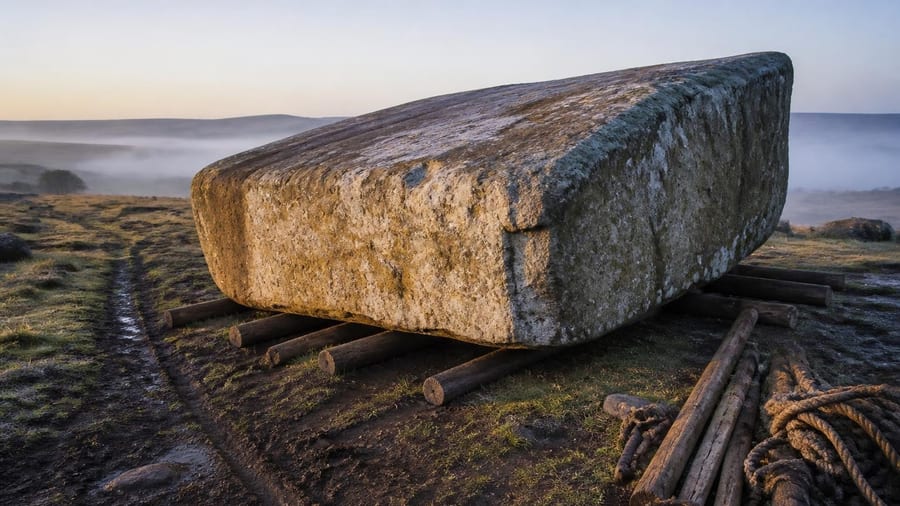
For decades, archaeologists have puzzled over the origins of Stonehenge's massive stones. Among them, the Altar Stone—a six-ton sandstone megalith nestled at the monument's heart—has sparked particular intrigue. Recent findings from researchers now suggest this colossal block journeyed approximately 700 kilometers from northeast Scotland to England's Salisbury Plain, and that ancient communities orchestrated the move without the help of Ice Age glaciers.
The scale of this undertaking challenges conventional assumptions about prehistoric capabilities. Moving such a burden across Bronze Age Britain would have required coordination, planning, and physical labor on a level that reframes our understanding of Neolithic society.
Tracing the Stone's Scottish Roots
To pinpoint the Altar Stone's birthplace, investigators combined mineral grain dating with advanced computer simulations of ancient ice-sheet movement. The geochemical signature of the stone's minerals pointed unambiguously toward northeast Scotland, a region more than 400 miles from Stonehenge's current location.
Researchers then tested whether natural glacial transport could account for the stone's presence in southern England. Ice sheets during the last glacial maximum did move massive rocks southward, sometimes depositing them hundreds of miles from their origin. However, the modeling revealed a critical gap: while glaciers may have carried material partway—possibly as far as Dogger Bank, a submerged landmass in what is now the North Sea—no plausible glacial pathway extended into the Salisbury Plain region.
The evidence points to a deliberate, carefully planned movement across a challenging and varied landscape.
That finding eliminates the glacier hypothesis and leaves human transport as the most credible explanation. The implications are profound: Bronze Age people possessed not only the engineering know-how to move multi-ton stones but also the social organization to sustain such an effort over vast distances.
Engineering Feats of the Bronze Age
Transporting a six-ton stone over rough terrain demands more than brute strength. Ancient communities would have needed specialized tools, knowledge of friction-reducing techniques, and likely some form of staged logistics. Researchers propose that the journey unfolded in segments, blending overland hauling with water-based routes where geography allowed.
Rivers and coastal waters would have offered significant advantages. Floating the stone on a raft or using tidal channels could reduce the physical burden, especially across marshlands or tidal estuaries. Overland sections, by contrast, would have required sledges, rollers fashioned from timber, and teams of laborers working in coordinated shifts.
- Sledges made from hardwood beams to distribute weight
- Log rollers placed beneath the sledge to minimize ground friction
- Ropes woven from plant fibers or leather for hauling
- Water routes via rivers or coastal passages to bypass difficult terrain
- Seasonal timing to exploit firm ground or high tides
Each stage would have demanded careful planning. Routes had to be scouted in advance, supplies stockpiled, and labor forces mobilized—all without the written records or centralized state structures that later civilizations relied upon.
Why Scotland? The Cultural Dimension
The distance raises an obvious question: why source a stone from Scotland when plenty of rock existed closer to Stonehenge? The answer likely lies in symbolic or spiritual significance rather than simple convenience.
Stonehenge is widely understood as a ritual monument, aligned with solar events and serving as a gathering place for communities across Britain. Stones from distant regions may have carried associations with ancestral lands, sacred sites, or important lineages. Transporting the Altar Stone from Scotland could have reinforced social bonds, demonstrated collective strength, or honored a specific group's heritage.
Other elements of Stonehenge—such as the bluestones quarried in Wales—also traveled long distances, suggesting that remote sourcing was a deliberate choice woven into the monument's design. These journeys themselves may have been ritualistic, transforming the act of construction into a pilgrimage or communal endeavor.
The Logistics of Long-Distance Cooperation
Organizing such a feat required more than muscle. It demanded sustained cooperation among groups spread across vast territories, possibly including multiple tribes or clans. The journey would have taken weeks or months, with participants needing food, shelter, and tools along the way.
| Challenge | Likely Solution |
|---|---|
| Weight distribution | Sledges with wide runners |
| Terrain obstacles | Staged transport via rivers and coasts |
| Labor coordination | Rotating teams from allied communities |
| Navigation | Oral knowledge of trails and waterways |
Archaeological evidence from other Neolithic sites reveals that Bronze Age societies were far from isolated. Trade networks stretched across Britain and into continental Europe, moving copper, tin, amber, and other goods. The infrastructure and social trust that enabled trade would have also supported large-scale construction projects like Stonehenge.
Implications for Prehistoric Society
The Altar Stone's journey upends older narratives that painted early Britons as small, isolated bands lacking the capacity for large-scale collaboration. Instead, the evidence suggests a society capable of long-term planning, resource management, and symbolic thinking.
These communities possessed deep environmental knowledge. They understood river systems, tidal patterns, and seasonal weather—all critical for timing a lengthy expedition. They also had the social cohesion to mobilize labor, share resources, and sustain collective purpose over extended periods.
Moreover, the choice to move such a stone underscores the importance of ritual and belief in prehistoric life. Stonehenge was not merely functional; it was a statement of identity, cosmology, and communal ambition. The effort invested in its construction reflects values that transcended survival, pointing to a rich cultural life.
Unanswered Questions and Future Research
While the new findings clarify the Altar Stone's origin and rule out glacial transport, many details remain elusive. The exact route taken, the number of people involved, and the duration of the journey are still speculative. Future research may uncover additional clues by examining ancient pathways, analyzing pollen and sediment samples along proposed routes, or investigating other stones at Stonehenge for similar distant origins.
Advances in geochemical analysis and computational modeling will continue to refine our picture of prehistoric logistics. As archaeologists apply these tools to other megalithic sites across Europe, a clearer portrait of Neolithic engineering and society will emerge.
This information does not replace advice from a qualified professional. Readers interested in archaeological interpretation should consult peer-reviewed research and expert analysis.