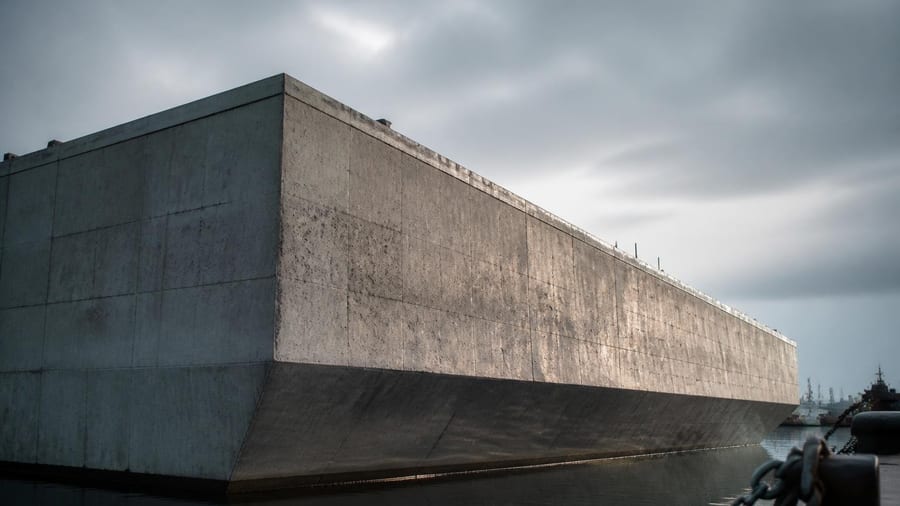
When you think about what keeps a boat afloat, concrete probably isn't the first material that comes to mind. Heavy, brittle, and more commonly associated with sidewalks and foundations than seafaring vessels, concrete seems like the last thing you'd want to build a ship from. Yet history proves otherwise. Engineers have successfully designed and launched concrete boats that not only floated but served critical roles during wartime and beyond. The secret lies not in defying physics, but in applying fundamental principles of buoyancy with precision and ingenuity.
Understanding how concrete boats work requires revisiting the core concept that governs all floating objects: Archimedes' Principle. This ancient rule of physics states that any object submerged in a fluid experiences an upward force equal to the weight of the fluid it displaces. When that upward buoyant force matches or exceeds the object's weight, the object floats. That's why a massive steel cargo ship can sail the oceans while a small pebble sinks immediately—it's not about the material's weight alone, but about the relationship between weight and displaced water volume.
The Physics Behind Buoyancy and Displacement
The reason a solid block of concrete sinks is straightforward: concrete has a density of roughly 2,400 kilograms per cubic meter, while freshwater sits at 1,000 kilograms per cubic meter. Drop a concrete slab into a lake, and it heads straight to the bottom. But shape that same amount of concrete into a hollow hull with enough interior volume, and suddenly the math changes entirely.
A boat—whether made from steel, aluminum, or concrete—creates a large cavity filled mostly with air. Air has negligible weight compared to water, so the average density of the entire structure (concrete walls plus air cavity) can be lower than water's density. When engineers calculate the total volume of the hull below the waterline and compare it to the boat's total weight, they're looking for equilibrium. If the weight of displaced water exceeds the vessel's weight, the boat floats.
The key engineering challenge is maximizing internal volume while minimizing wall thickness, all without compromising structural integrity under the immense pressure of water.
Concrete boats rely on reinforced concrete technology, where steel rebar or mesh is embedded within the concrete matrix. This reinforcement provides tensile strength that plain concrete lacks, preventing catastrophic cracking when waves, cargo loads, or impacts stress the hull. Without reinforcement, a concrete vessel would fracture easily and flood.
Wartime Innovation and Material Shortages
The practical development of concrete ships in the United States emerged not from curiosity but from necessity. During both World War I and World War II, steel became a precious commodity diverted primarily to weapons, tanks, and aircraft production. Shipbuilders faced a dilemma: how to maintain merchant and auxiliary fleets when traditional boatbuilding materials were scarce.
In response to World War I shortages, Norwegian engineer N.K. Fougner pioneered concrete ship research in the United States, demonstrating that reinforced concrete hulls could indeed support cargo and withstand ocean conditions. President Woodrow Wilson's administration authorized construction of 24 concrete vessels, though the war ended before most were completed. Roughly half eventually entered service, proving the concept viable if not ideal.
World War II brought renewed urgency. Between 1943 and 1945, American shipyards produced concrete vessels at a rate of approximately one per month. These weren't pleasure craft—they were functional workhorses designed to transport supplies, serve as floating warehouses, or fulfill specialized military roles. Some concrete ships even participated in combat operations, including the D-Day invasion at Normandy, where they were deliberately sunk as breakwaters to calm seas for landing craft.
Design Challenges and Engineering Trade-offs
Building a seaworthy concrete vessel demands careful attention to several competing factors:
- Wall thickness: Thicker walls provide strength but add weight, reducing buoyancy. Engineers must find the minimum thickness that maintains structural integrity.
- Hull shape: Hydrodynamic efficiency matters. Concrete's rigidity during casting allows complex curves, but the material's weight makes sleek, fast designs difficult.
- Reinforcement placement: Steel bars must be positioned to handle tensile stresses where concrete alone would crack, particularly at joints and points of concentrated load.
- Waterproofing: Concrete is porous. Specialized coatings and mix designs with low permeability are essential to prevent water infiltration that would increase weight and promote corrosion of internal reinforcement.
- Cargo distribution: Loading must be planned to maintain proper trim and stability, as concrete hulls have less flexibility for center-of-gravity adjustments than metal counterparts.
These constraints explain why concrete ships never replaced conventional vessels in peacetime. They were slower, harder to repair, and less adaptable than steel ships. Their primary advantage was simple: they could be built when steel wasn't available.
Modern Applications and Engineering Competitions
While commercial concrete shipping remains rare, the principles live on in specialized applications. Floating concrete platforms serve as bridges, docks, and offshore structures where buoyancy is required but mobility is less critical. Some smaller concrete boats still operate as pleasure craft, particularly in regions with limited access to metal but abundant cement.
Universities around the world host concrete canoe competitions, where engineering students design, build, and race lightweight concrete boats. These events showcase advances in concrete technology—ultra-high-performance concrete mixes, fiber reinforcement, and optimized hull geometries—that push the boundaries of what's possible. Winning teams produce canoes weighing as little as 200 pounds that still support multiple paddlers.
| Material Property | Concrete | Steel |
|---|---|---|
| Density (kg/m³) | 2,400 | 7,850 |
| Tensile Strength | Low (requires reinforcement) | High |
| Corrosion Resistance | Moderate (with proper sealing) | Low (requires coatings) |
| Ease of Shaping | High (when wet) | Moderate |
Why Concrete Ships Didn't Last
After World War II, as steel production ramped up and material shortages eased, concrete shipbuilding essentially vanished from mainstream maritime industries. The reasons are practical: steel ships are lighter for their strength, faster to construct using modern welding techniques, easier to repair, and more adaptable for retrofitting with new equipment.
Concrete vessels also presented maintenance headaches. Cracks that develop over time can compromise watertight integrity, and patching concrete underwater is far more difficult than welding a steel plate. The material's brittleness means impact damage tends to be more severe and less predictable than with ductile metals.
Speed was another limitation. The added weight of concrete hulls meant higher displacement and greater drag, resulting in slower maximum speeds and higher fuel consumption per mile traveled. In a commercial shipping world where time is money, these inefficiencies made concrete uncompetitive.
The Enduring Lesson of Adaptive Engineering
The story of concrete boats illustrates a broader principle: when constraints force innovation, engineers find ways to make the improbable work. The same physics that keeps a steel freighter afloat applies equally to a concrete hull—it's just a matter of designing the geometry and managing the weight-to-volume ratio with precision.
Today's maritime industry has moved on to advanced materials like composites and specialized alloys, but the concrete ships of the 1940s remain a testament to human ingenuity under pressure. They sailed, they carried cargo, and a few even survived combat. That they worked at all is a reminder that with sufficient understanding of fundamental principles, even the most unlikely materials can be coaxed into performing unexpected tasks.
This article provides educational information about engineering principles and historical maritime technology. It does not replace professional advice for vessel design, construction, or operation.