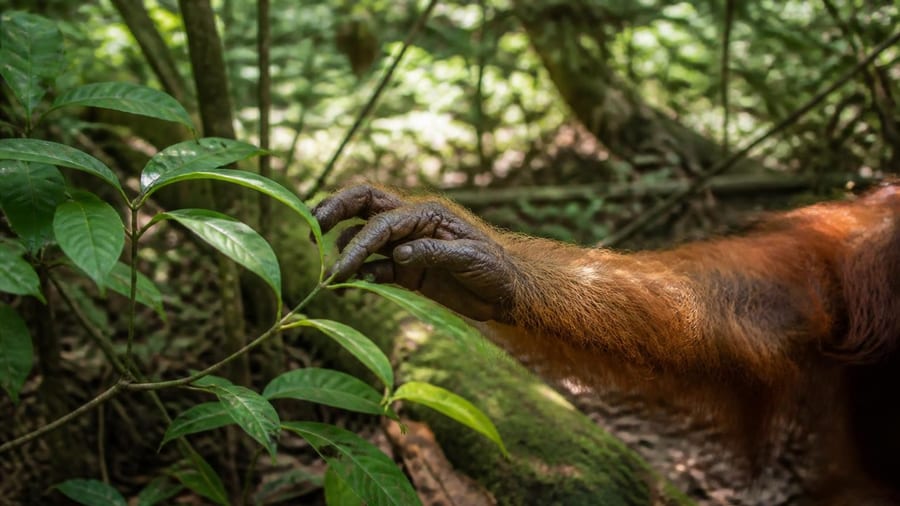
Deep in the rainforests of Borneo and Sumatra, orangutans have been observed engaging in behavior that appears remarkably deliberate: consuming plants with known medicinal properties in patterns that suggest they are treating specific ailments. This phenomenon, documented by primatologists over the past two decades, offers compelling evidence that self-medication is not unique to humans and may represent an ancient survival strategy shared across the great ape lineage.
The practice, known scientifically as zoopharmacognosy, describes how animals select and use plant-based remedies to prevent or cure disease. While examples exist across the animal kingdom—from butterflies laying eggs on toxic plants to protect their larvae to parrots consuming clay to neutralize dietary toxins—the behavior in orangutans stands out for its apparent complexity and selectivity.
Targeted Plant Consumption in the Wild
Researchers studying orangutan populations in protected habitats have cataloged instances where individuals consume plants they otherwise avoid. These plants often contain compounds with anti-inflammatory, antimicrobial, or analgesic properties. In several documented cases, orangutans chew the leaves or bark of specific trees, swallow the juice, and discard the pulp—a behavior that maximizes exposure to the plant's bioactive chemicals while minimizing fiber intake.
One particularly striking observation involved an adult female orangutan with visible injuries who spent time processing the leaves of a vine known locally to indigenous communities for its wound-healing properties. The ape applied the chewed material directly to the injured area, a form of topical self-treatment rarely seen in non-human primates. Days later, the wound showed signs of reduced inflammation and improved healing.
Scientists have identified more than a dozen plant species consumed by orangutans in patterns inconsistent with ordinary foraging, suggesting deliberate therapeutic intent rather than random dietary variation.
Chemical Analysis Supports Medicinal Hypothesis
Laboratory analysis of the plants favored during these episodes has revealed a pharmacological treasure trove. Several species contain alkaloids, tannins, and flavonoids with proven bioactivity in human medicine. One tree bark frequently consumed by orangutans harbors compounds effective against parasitic infections, while another produces chemicals that reduce gastrointestinal inflammation.
The timing of consumption further supports the self-medication hypothesis. Orangutans appear to seek out these plants when displaying symptoms of illness—lethargy, reduced appetite, or visible discomfort—rather than incorporating them regularly into their diet. This selective, context-dependent use mirrors how humans might take aspirin for a headache but not consume it daily without cause.
Cultural Transmission and Learning
Evidence suggests that knowledge of medicinal plants may be passed down through orangutan populations via social learning. Juveniles have been observed watching their mothers carefully select and process specific plants, then attempting to replicate the behavior. This cultural transmission of pharmacological knowledge adds another layer of sophistication to orangutan cognition and raises questions about the evolutionary origins of herbal medicine in hominids.
Different orangutan populations exhibit preferences for different medicinal plants, even when their habitats overlap in flora composition. This geographic variation in plant use parallels the way human cultures have independently discovered and utilized local medicinal resources, suggesting that orangutans, like humans, possess the cognitive capacity to experiment with and remember the therapeutic properties of plants in their environment.
Observational Challenges and Research Methods
Studying self-medication in wild orangutans presents significant methodological challenges. Unlike laboratory settings where variables can be controlled, field researchers must:
- Track individual orangutans over extended periods to document health status and dietary choices
- Collect plant samples for chemical analysis without disturbing the animals or their habitat
- Distinguish between medicinal consumption and incidental ingestion during normal foraging
- Correlate plant use with observable symptoms or subsequent recovery
Long-term field studies, some spanning decades, have been essential in establishing the patterns that differentiate medicinal plant use from general dietary behavior. Camera traps, GPS tracking, and non-invasive health monitoring techniques have enhanced researchers' ability to document these rare but significant events.
Implications for Conservation and Ethnobotany
The discovery that orangutans practice self-medication carries important implications beyond primatology. Conservation efforts gain urgency when we recognize that these great apes possess complex knowledge systems that could be lost as habitats shrink. Each orangutan population may harbor unique botanical knowledge refined over generations, representing a library of natural pharmacology at risk of extinction.
Indigenous communities in Borneo and Sumatra have long observed orangutan behavior and incorporated some of the same plants into their traditional medicine. This convergence of human and orangutan ethnobotany suggests that our hominid ancestors may have learned medicinal plant use through observation of other species, or that all great apes share an innate capacity to recognize therapeutic plants through trial and error.
| Plant Type | Observed Use | Known Bioactive Compounds |
|---|---|---|
| Dracaena bark | Chewed during digestive distress | Saponins, anti-inflammatory agents |
| Ficus leaves | Consumed when lethargic | Alkaloids, antimicrobial properties |
| Spatholobus vine | Topical wound treatment | Tannins, astringent compounds |
The Evolutionary Perspective
Self-medication behavior in orangutans offers a window into the evolutionary origins of healthcare. If our closest genetic relatives can identify and use medicinal plants, the roots of human medicine may extend far deeper than written history suggests. Early hominids likely possessed similar abilities, experimenting with plants in their environment and retaining knowledge of those that provided relief or healing.
This capacity for self-care may have conferred significant survival advantages, particularly in tropical environments rich in parasites, pathogens, and toxic plants. The ability to self-medicate could have reduced mortality, increased reproductive success, and allowed populations to exploit new ecological niches—all key factors in human evolution.
This information does not replace advice from a qualified professional. Observations of animal behavior should not be used to guide human medical decisions without proper scientific validation and clinical testing.