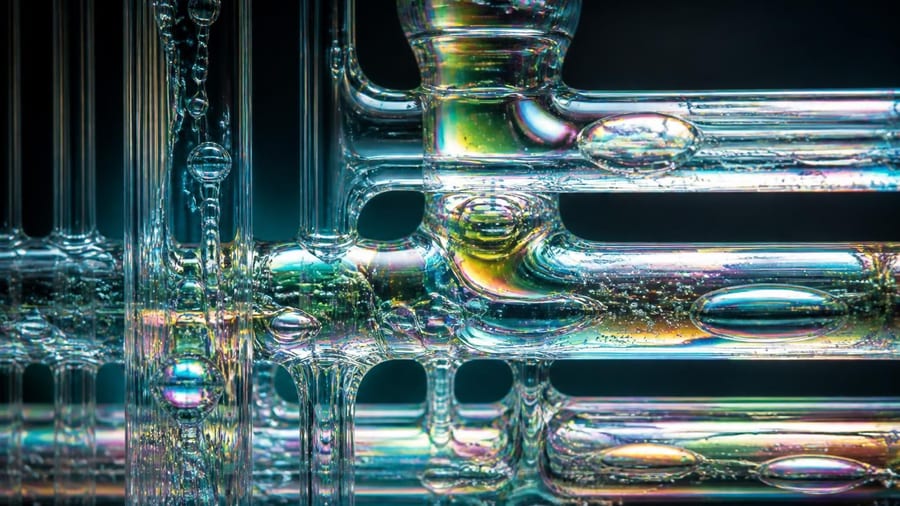
At dimensions measured in billionths of a meter, the familiar laws of fluid mechanics break down. Water no longer behaves like water. Flow becomes choppy, molecular. In the emerging field of nanofluidics, researchers are discovering that when you shrink pipes and channels to the width of a few dozen molecules, physics takes a sharp detour into the quantum realm.
This frontier—where chemistry, physics, and engineering converge—holds promise for faster medical diagnostics, more efficient energy storage, and even new computing paradigms. Yet progress depends on understanding phenomena that classical equations simply cannot predict.
What Happens When Channels Shrink Below 100 Nanometers
Traditional fluid dynamics assumes that liquids are continuous substances. Pour water through a garden hose, and engineers can calculate pressure, velocity, and turbulence with elegant precision. But when the diameter of a channel drops below 100 nanometers—roughly one-thousandth the width of a human hair—those assumptions collapse.
At this scale, individual water molecules interact directly with channel walls. Surface forces dominate over bulk pressure. Electrostatic charges on a solid surface can pin molecules in place or repel entire layers. Flow becomes a matter of molecular negotiation rather than hydrodynamic push.
Researchers have observed surprising behaviors: liquids that refuse to wet surfaces they would normally coat, ion transport that accelerates or halts abruptly, and slip conditions that violate the no-slip boundary assumption central to classical fluid mechanics. These deviations are not anomalies—they are the new rules.
Quantum Effects in Confined Fluids
Shrink the channel further, and quantum mechanics enters the picture. When confinement approaches the de Broglie wavelength of particles—a few angstroms for light atoms—quantum tunneling and zero-point energy begin to influence molecular motion.
Water confined in carbon nanotubes exhibits proton quantum behavior that classical models fail to capture, opening questions about hydrogen bonding at the atomic limit.
Experimental groups have documented proton delocalization in tightly confined water, where hydrogen nuclei occupy smeared probability clouds rather than fixed positions. This quantum fuzziness alters hydrogen-bond networks, changing viscosity, dielectric properties, and even the freezing point of water inside nanochannels.
Such findings challenge textbook chemistry. They also suggest that nanofluidic devices could exploit quantum states to perform tasks impossible at larger scales—filtering ions with atomic precision, for instance, or catalyzing reactions by tuning quantum confinement.
Engineering Applications: From Diagnostics to Desalination
The practical payoff for mastering molecular plumbing is substantial. Nanofluidic chips are already enabling single-molecule analysis in biology. By threading DNA through nanopores barely wider than the double helix, scientists can sequence genetic material in real time, watching individual bases pass through a sensor.
In energy storage, researchers are designing supercapacitors with nanoporous electrodes that pack ions into confined geometries, boosting charge density. The unusual ion transport observed in nanofluidic systems—sometimes orders of magnitude faster than bulk diffusion—could accelerate charging cycles and extend battery life.
Desalination technologies stand to benefit, too. Membrane materials engineered with sub-nanometer channels can sieve salt ions from water with unprecedented selectivity. Because quantum and surface effects govern passage at this scale, membranes can be tuned to reject specific contaminants while allowing water molecules to flow freely.
- Lab-on-a-chip diagnostics for early disease detection
- High-efficiency water purification systems
- Advanced energy storage with nanoporous materials
- Chemical synthesis in confined reaction chambers
- Quantum sensing platforms for environmental monitoring
Measurement Challenges and Computational Models
Observing what happens inside a nanochannel is no simple feat. Optical microscopy cannot resolve features below the diffraction limit of light. Electron microscopes require vacuum conditions incompatible with liquids. Researchers have turned to indirect methods: measuring electrical conductance as ions move through pores, using X-ray scattering to infer molecular arrangements, or employing atomic force microscopy to probe surface interactions.
Computational modeling has become indispensable. Molecular dynamics simulations track thousands of atoms over nanoseconds, revealing how water arranges itself near charged walls or how ions jostle through a crowded channel. Quantum chemistry calculations refine those models by accounting for electron clouds and bond vibrations that classical force fields miss.
Yet even the fastest supercomputers struggle with the timescales relevant to real experiments. A nanofluidic device might operate for seconds or minutes, while simulations capture mere nanoseconds. Bridging that gap requires multiscale approaches that stitch together quantum, molecular, and continuum descriptions—a frontier of computational science in its own right.
Material Science Meets Fluid Mechanics
The surfaces that confine nanofluids matter as much as the fluids themselves. Carbon nanotubes, graphene sheets, silicon nitride membranes, and metal-organic frameworks each impose distinct boundary conditions. A hydrophobic carbon surface might allow water to slip past with minimal friction, while a hydrophilic oxide could anchor molecules tightly.
| Material | Characteristic | Nanofluidic Behavior |
|---|---|---|
| Carbon nanotubes | Atomically smooth, hydrophobic | Enhanced flow rates, low friction |
| Silicon nitride | Chemically tunable, robust | Controlled ion selectivity |
| Graphene oxide | Tunable interlayer spacing | Precise molecular sieving |
| Metal-organic frameworks | Porous, high surface area | Catalytic confinement effects |
Researchers are learning to engineer these surfaces at the atomic level—adding functional groups to modulate charge, etching channels with nanometer precision, or layering materials to create gradients in wettability. The goal is to design "smart" nanofluidic systems that respond dynamically to their chemical environment.
Future Directions and Open Questions
Despite rapid progress, fundamental questions remain. How do quantum fluctuations influence macroscopic flow over long times? Can nanofluidic devices achieve the reliability needed for clinical or industrial deployment? What new physics emerges when multiple phases—liquid, gas, solid—coexist in nanoscale confinement?
Interdisciplinary collaboration is accelerating discovery. Physicists bring quantum theory, chemists contribute molecular insights, and engineers translate findings into devices. National laboratories and university centers are establishing shared facilities where experimentalists and theorists work side by side, iterating designs in real time.
As fabrication techniques improve and computational power grows, the boundary between exploring nanofluidic phenomena and exploiting them for technology will blur. The molecular plumbing that today puzzles researchers may soon underpin the next generation of sensors, purifiers, and energy systems.
This article discusses fundamental research in physics and engineering. It does not provide specific technical recommendations for device design or implementation. Consult peer-reviewed literature and qualified specialists for guidance on nanofluidic applications.