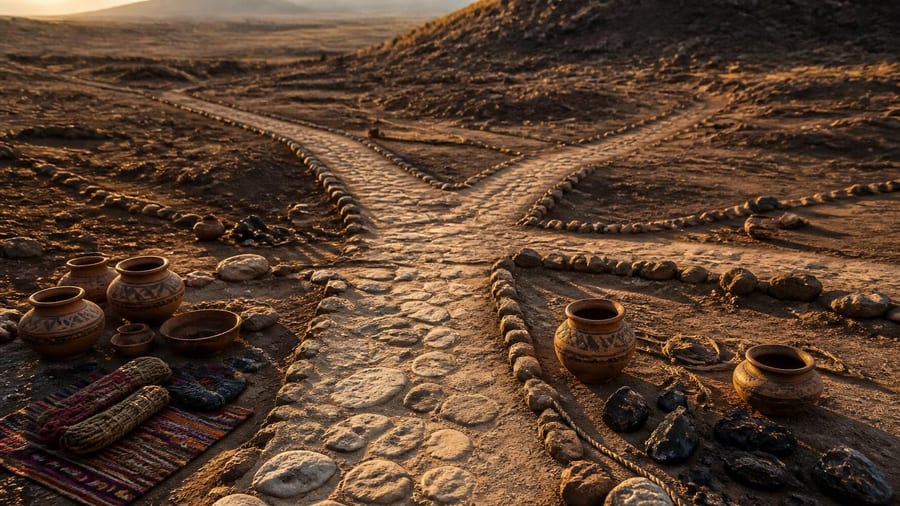
Modern disaster planners emphasize redundancy, connectivity, and resource-sharing as pillars of resilience. Yet these principles are anything but new. Long before written records or formal institutions, prehistoric communities crafted intricate social networks that enabled them to survive droughts, famines, and climate shifts. Archaeological evidence increasingly suggests that early human groups thrived not because of isolation or self-sufficiency, but through deliberate connection.
From the Paleolithic hunters who exchanged flint across hundreds of miles to Neolithic farmers who shared seed stock during lean years, the fossil and artifact record points to a startout truth: our ancestors understood that survival was a team sport. Today, scholars mining burial sites, stone-tool distributions, and settlement patterns are reconstructing these ancient webs—and discovering lessons that remain relevant in an era of globalized risks.
Trade Routes as Insurance Networks
One of the clearest markers of prehistoric resilience is the movement of raw materials far beyond their geological sources. Obsidian from central Anatolia has been found in Levantine sites more than 500 miles away, dating to approximately 12,000 years ago. Shell beads from coastal regions appear in inland burial contexts across Europe and Africa, sometimes crossing multiple climate zones.
These objects represent more than commerce; they trace exchange relationships that functioned as mutual-aid agreements. When a drought struck one valley, its inhabitants could call on partners in wetter regions for grain or game. When volcanic eruptions rendered local stone unusable, distant quarries remained accessible through established ties. Redundancy in supply chains, archaeologists argue, was baked into the system long before anyone coined the term.
| Material | Source Region | Found Distance | Approximate Period |
|---|---|---|---|
| Obsidian | Central Anatolia | 500+ miles | 12,000 years ago |
| Spondylus Shell | Aegean Coast | 800+ miles | 7,000 years ago |
| Jade Axes | Italian Alps | 600+ miles | 6,000 years ago |
Kinship Structures and Risk Pooling
Genetic analyses of ancient burial grounds reveal that many prehistoric settlements housed individuals from diverse lineages. This pattern contradicts the stereotype of insular, xenophobic bands. Instead, it points to exogamy—the practice of marrying outside one's immediate group—as a deliberate strategy for building alliances.
When a young woman from one valley married into a neighboring community, she carried with her not only genes but also knowledge: crop varieties adapted to different soils, herbal remedies, techniques for preserving meat. Her children inherited dual loyalties, creating durable links between groups that could be activated in times of need. Over generations, these kinship networks stitched together regions that might otherwise have remained isolated.
Isotope studies of teeth and bones confirm that individuals often migrated multiple times during their lives, suggesting fluidity rather than rigid territoriality. This mobility allowed populations to redistribute themselves in response to local shocks, much as modern migrants move toward opportunity and away from disaster.
Shared Ritual and Collective Memory
Monumental architecture—from Göbekli Tepe's T-shaped pillars to Stonehenge's sarsen circle—required coordinated labor from multiple communities, cementing social bonds through shared effort and ceremony.
Feasting sites excavated across Europe and the Near East show evidence of periodic gatherings where hundreds of people consumed prodigious quantities of meat and beer. These events were not mere parties; they were opportunities to negotiate marriages, settle disputes, and reinforce norms of reciprocity. The elaborate preparations—slaughtering dozens of animals, brewing fermented beverages, constructing temporary shelters—demonstrated a group's capacity and willingness to host, a form of social capital that could be drawn upon later.
Oral traditions, though invisible in the archaeological record, likely played a crucial role. Stories about past crises and successful responses would have circulated at these gatherings, encoding adaptive strategies in memorable narratives. Communities that preserved and transmitted such knowledge were better equipped to recognize warning signs and coordinate responses.
Environmental Monitoring and Adaptive Flexibility
Resilient prehistoric societies did not simply react to disasters; they anticipated them. Pollen cores and phytolith studies reveal that many groups practiced diversified subsistence strategies, cultivating multiple crop species, hunting a wide range of game, and fishing or foraging as conditions allowed. This diversification cushioned them against the failure of any single resource.
Settlement patterns also reflect adaptive flexibility. In regions prone to flooding, communities built on elevated ground but maintained seasonal camps in floodplains to exploit fertile soils after inundations. In arid zones, groups oscillated between aggregation during wet periods and dispersion during droughts, a rhythm that balanced social cohesion with resource constraints.
Some archaeologists point to evidence of intentional landscape management—controlled burns to encourage certain plant species, fish weirs to regulate catches, terracing to prevent erosion—as signs that prehistoric peoples actively shaped their environments to enhance stability. These practices required collective decision-making and enforcement, further strengthening social ties.
Collapse and Recovery Cycles
Not all prehistoric communities succeeded. The archaeological record is littered with abandoned settlements and cultural discontinuities. Yet even these apparent failures offer insights into resilience. Many sites show evidence of reoccupation after abandonment, sometimes by the same group, sometimes by newcomers who inherited infrastructure and knowledge.
What distinguishes groups that recovered from those that vanished? Connectivity appears central. Isolated populations, cut off by geography or conflict, lacked the external ties to draw on when internal resources failed. In contrast, well-networked communities could temporarily relocate, merge with allies, or receive aid until conditions improved.
The Norse Greenland colonies, though post-prehistoric, illustrate this dynamic. Their eventual collapse is often attributed to environmental change, but recent research emphasizes their failure to maintain trade links with Europe and to adopt Inuit survival strategies. In contrast, contemporary Inuit populations, embedded in robust exchange networks, thrived under the same conditions.
Lessons for Modern Resilience
Contemporary policymakers grappling with climate change, pandemics, and supply-chain disruptions may find unexpected guidance in the prehistoric past. Ancient social networks were characterized by several features now recognized as critical to resilience:
- Redundancy: Multiple pathways for resource access reduced single points of failure.
- Diversity: Varied subsistence strategies and partner communities provided options when primary plans faltered.
- Trust: Long-term relationships, often reinforced through ritual and kinship, ensured cooperation under stress.
- Flexibility: Willingness to relocate, adopt new practices, or restructure groups allowed adaptation to changing conditions.
Modern institutions, with their emphasis on efficiency and specialization, sometimes sacrifice these qualities. Just-in-time supply chains minimize inventory costs but collapse when disrupted. Centralized decision-making accelerates action but fails when the center is compromised. Prehistoric societies, lacking the luxury of surplus, built resilience into the social fabric itself.
This information does not replace advice from qualified professionals in archaeology, anthropology, or disaster management. Interpretations of prehistoric societies rely on incomplete evidence and evolving research.