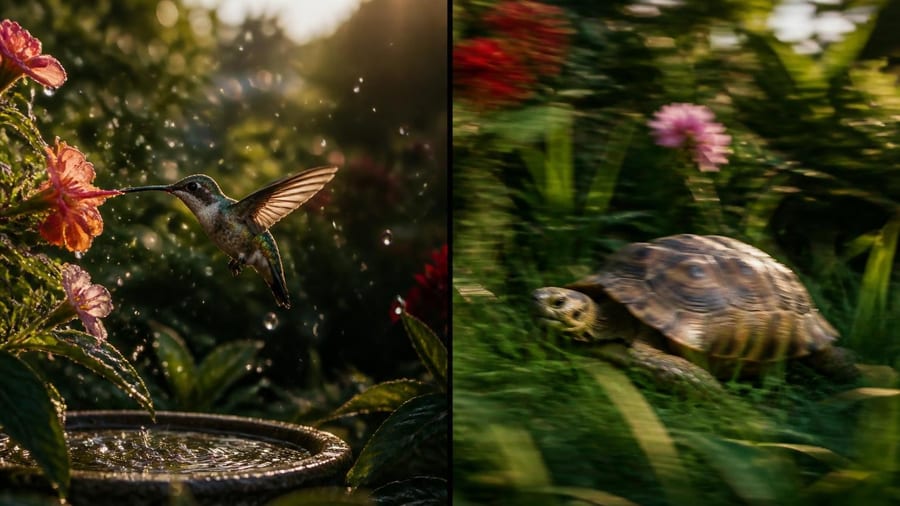
Humans often assume that other creatures experience the world at the same pace we do, but emerging research into temporal perception suggests reality is far more complex. The concept of "timescapes"—the subjective experience of time's passage for different species—offers a framework for understanding why a housefly evades a swatter so effortlessly while a tortoise appears to move in slow motion.
Scientists studying neural processing speeds across the animal kingdom have discovered that temporal resolution varies enormously between species. While humans perceive roughly 60 discrete visual frames per second, a fly processes more than 200, effectively experiencing our movements as if in slow motion. Conversely, larger animals with slower metabolisms may perceive fewer frames, creating their own unique temporal reality.
The Biology Behind Temporal Perception
Temporal perception hinges on how quickly an organism's nervous system can process incoming sensory information. Smaller animals with faster metabolisms generally exhibit quicker neural processing rates, which translates to a higher critical flicker fusion frequency—the threshold at which flickering light appears continuous.
Research comparing metabolic rates to visual processing speeds across vertebrates and invertebrates reveals a consistent pattern: body size and metabolic activity strongly predict how an animal experiences the flow of time. This biological constraint shapes everything from predator-prey dynamics to courtship displays.
- Flies and small birds process visual information at rates exceeding 200 Hz
- Dogs perceive approximately 75 frames per second, making standard television appear flickery
- Humans clock in around 60 Hz under normal conditions
- Large tortoises may process visual information at rates below 15 Hz
Evolutionary Advantages of Faster Timescapes
The ability to perceive time at different rates confers distinct survival advantages. For prey species, faster temporal processing means predators telegraph their movements in advance, providing precious milliseconds to escape. A hummingbird hovering near a flower processes visual data so rapidly that it can make instantaneous course corrections in mid-flight, avoiding obstacles invisible to slower-processing animals.
Understanding that animals inhabit fundamentally different temporal worlds forces us to reconsider how we interpret their behavior and design environments that accommodate their sensory experiences.
Predators also exploit temporal perception differences. A chameleon's tongue strike appears lightning-fast to human observers, but from the chameleon's perspective—with its relatively slow visual processing—the movement unfolds at a more deliberate pace, allowing precise targeting. The prey insect, however, often lacks sufficient processing speed to react before capture.
Measuring Time Perception Across Species
Neuroscientists employ several methods to quantify temporal perception. The most common involves measuring critical flicker fusion frequency by presenting animals with increasingly rapid light pulses until they can no longer distinguish individual flashes. Electroretinography records electrical responses from the retina, revealing how quickly visual signals propagate through neural pathways.
| Animal Group | Approximate Visual Processing Rate (Hz) | Relative Time Experience |
|---|---|---|
| Flies | 200-250 | 4x faster than humans |
| Small songbirds | 120-160 | 2x faster than humans |
| Dogs | 70-80 | Slightly faster than humans |
| Humans | 50-60 | Baseline |
| Large tortoises | 10-15 | 4x slower than humans |
Behavioral experiments complement physiological measurements. Researchers train animals to respond to visual stimuli presented at varying speeds, establishing perceptual thresholds. These studies consistently demonstrate that metabolic rate and body mass predict temporal resolution more reliably than evolutionary relatedness.
Implications for Animal Welfare and Conservation
Recognizing that animals experience time differently has practical implications for how humans interact with other species. Aquarium fish housed under standard fluorescent lighting may perceive constant flickering, potentially causing stress. Zoo designers increasingly consider temporal perception when selecting artificial lighting, opting for frequencies that appear continuous to the housed species.
Conservation efforts also benefit from this perspective. Migratory birds navigating urban environments face windows and structures that may appear as static obstacles to humans but flicker or shimmer in the birds' faster timescape, contributing to collision rates. Understanding these perceptual differences enables better architectural solutions.
Applications in Animal Training and Enrichment
Animal trainers apply timescape concepts to improve communication with non-human species. Dogs perceive human gestures and facial expressions at higher temporal resolution than we do, meaning subtle movements we consider instantaneous unfold across multiple perceptual frames for them. This explains why consistent, deliberate hand signals prove more effective than rapid or jerky motions during training sessions.
Enrichment programs for captive animals increasingly incorporate temporal considerations. Video displays designed for primates require higher refresh rates than standard screens to appear smooth and engaging rather than flickery and aversive.
The Subjective Nature of Experienced Time
While neural processing speed establishes the framework for temporal perception, subjective experience remains difficult to access across species barriers. An animal's attention, emotional state, and cognitive load all modulate how time feels, just as humans experience time dilation during emergencies or when deeply focused.
Comparative psychology suggests that species with more complex cognitive abilities may possess richer temporal experiences, potentially including episodic memory and future planning. Corvids, great apes, and cetaceans demonstrate behaviors consistent with mental time travel, though their subjective timescape remains speculative.
This information does not replace advice from a qualified professional. Understanding animal perception requires interdisciplinary expertise spanning neuroscience, ethology, and comparative psychology.